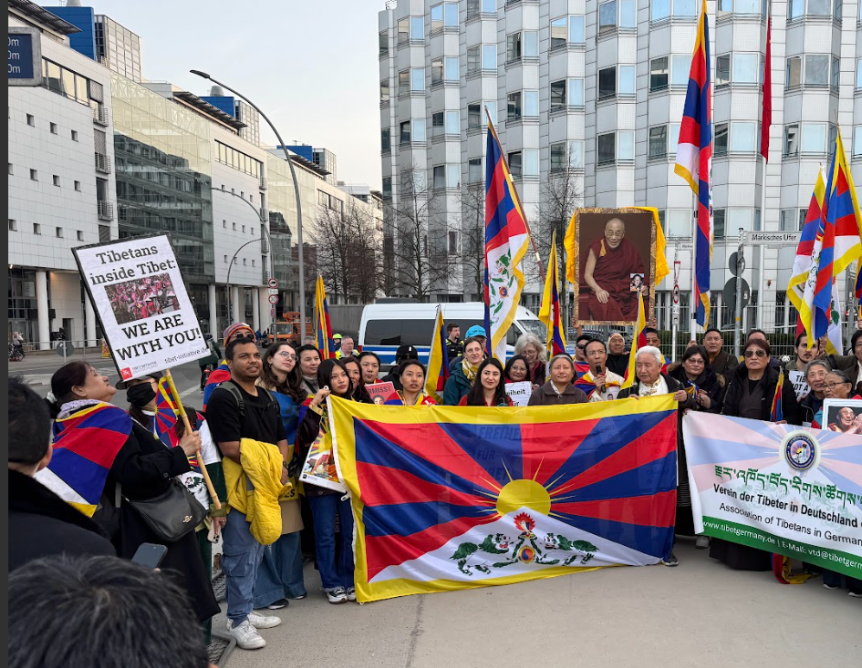
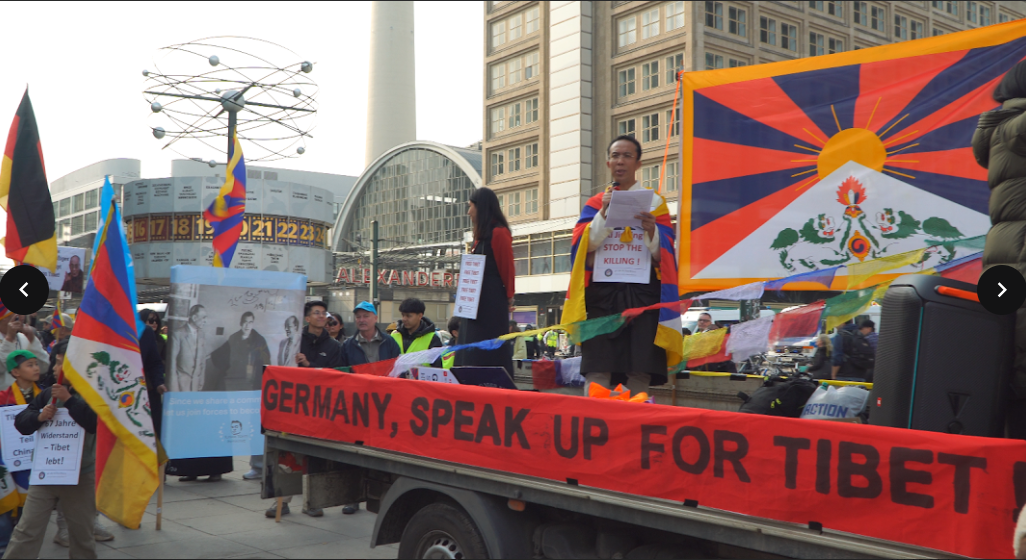
On March 10, 2026, the early spring air in Berlin remained chilly, but the crowd gathering at Alexanderplatz created a strikingly energetic atmosphere. The day marked the 67th anniversary of the 1959 Tibetan uprising. A rally organized by the Association of Tibetans in Germany (VTD) and the Tibet Initiative Germany (TID) drew participants from diverse groups. Tibetans, Uyghurs, Hong Kongers, Christians, and representatives of international human rights organizations gathered together to condemn the Chinese Communist Party (CCP) for its persecution of human rights.
The event began at 2:00 p.m. Standing on a temporary stage atop a truck bearing a banner reading “Germany, Speak Up for Tibet,” Dundup Donka, president of the Association of Tibetans in Germany, addressed the crowd. Speaking in German, he told the onlookers that although Tibet continues to face severe human rights challenges, the hope of the Tibetan people has never been extinguished. He called on the international community to pay attention to Tibetan children forced into boarding schools, where they gradually lose their language and cultural environment, as well as to “political prisoners” detained for remaining steadfast in their beliefs. He raised his arm and shouted “Böd Gyalo!” (“Victory to Tibet!”)—a chant echoed loudly by Tibetans and supporters in the crowd. The march then officially began.
The procession set out from Alexanderplatz and slowly made its way toward the German Foreign Ministry building. Bright Tibetan flags fluttered in the wind above the marchers, attracting many Berlin residents who stopped to watch, while others took out their phones to record the scene.
At the rally held in front of the German Foreign Ministry building, representatives of different communities delivered speeches in turn. A Uyghur representative spoke first, his words heavy with emotion. He described in detail the forced ideological indoctrination and cultural erasure policies implemented by the CCP in Xinjiang. He pointed out that prohibiting the use of native languages and stripping people of their ethnic identity is not only happening in Xinjiang but also in Tibet, becoming a shared reality faced by both peoples. Although they come from different ethnic backgrounds, he said, their shared experiences have made them companions bound by the same struggle.
Next, Amy Siu, a representative of Freedom for Hong Kong, shared what she described as a story of awakening. She frankly mentioned that in the past, the phrase “Free Tibet” had seemed to her like a distant slogan. But as the rule of law in Hong Kong deteriorated and many young Hong Kongers were imprisoned—or even lost their lives—for participating in the pro-democracy movement, she suddenly realized the heavy price behind those words. She called on oppressed groups to strengthen cooperation and help more people understand the truth.
The speech by Xiao Xiao, a representative of The Church of Almighty God (CAG), reflected this sense of solidarity that transcends ethnic boundaries. She said that even while living overseas, the shadow of transnational repression continues to make many people afraid to face the camera openly. Quoting the bible verse, “There is no fear in love,” she prayed for everyone present and expressed a simple and sincere hope: that Tibetan families might one day reunite, and that people of different faiths could live and worship freely in an environment without fear.
As the sun began to set, the marchers eventually arrived at the Chinese Embassy in Berlin. Facing the stark building, the atmosphere reached its climax. Tibetans stood together in silence and sang the Tibetan national anthem, their voices carrying both grief and an enduring longing for their homeland. A message of official greeting from the Central Tibetan Administration in Dharamshala was then read aloud. The words of support from thousands of miles away felt like a warm current flowing through the hearts of the exiles present.
After several hours on the streets of Berlin, the march concluded with chants of “We Want Human Rights!” The march was not only a commemoration of history but also a call for dignity and justice. As the crowd gradually dispersed into the evening light, the chant “We Are Connected!” continued to echo near Brandenburg Gate.