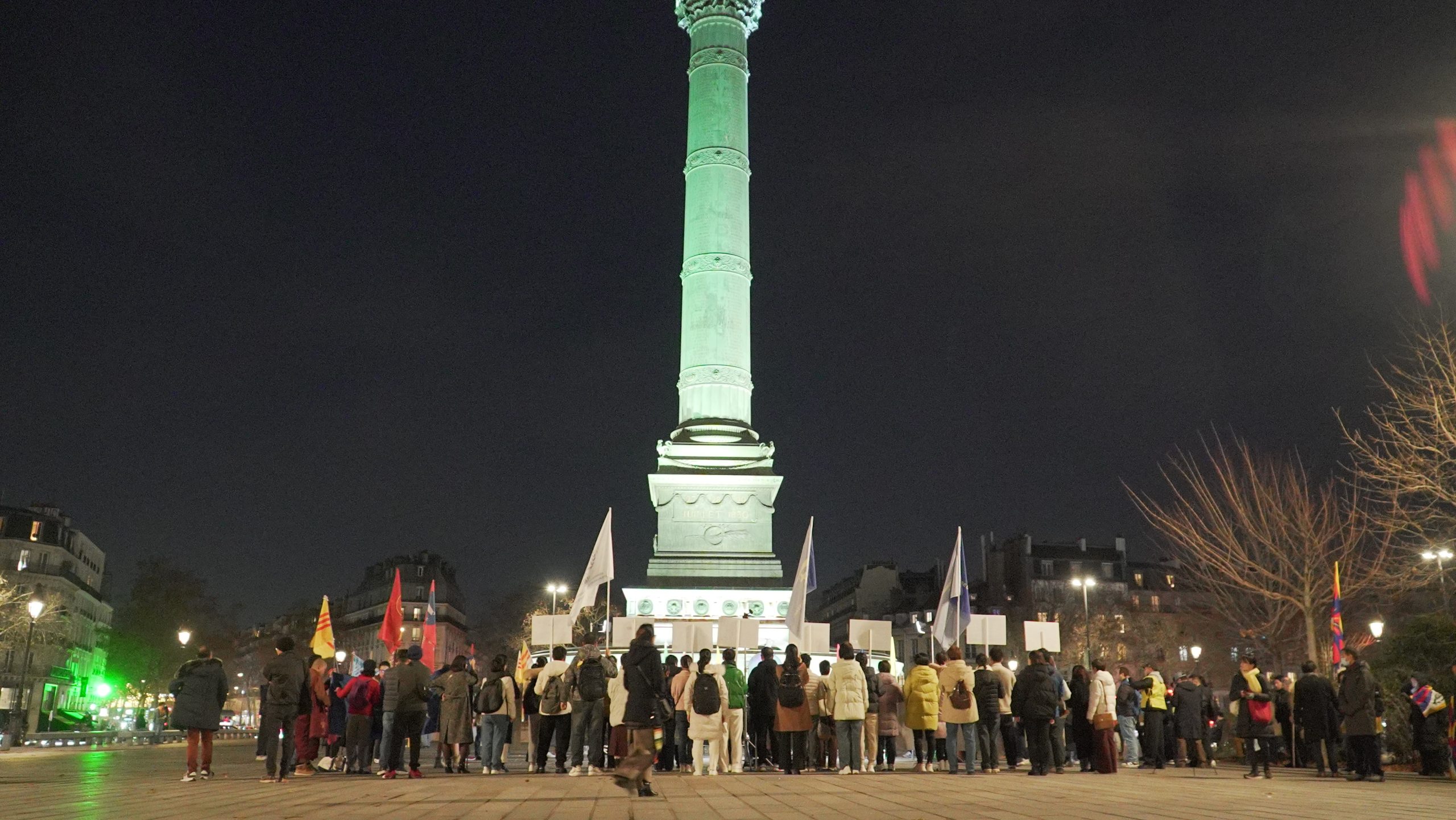
Paris, December 10, 2025 — On the 77th International Human Rights Day, Paris’s Place de la Bastille once again became a focal point for global human rights advocacy. That evening, human rights organizations, democracy groups, and religious communities from across Asia and Europe gathered at the square for a rally, speaking out to urge the international community to stand in solidarity with people still living under authoritarian repression and fighting for basic freedoms and human dignity.
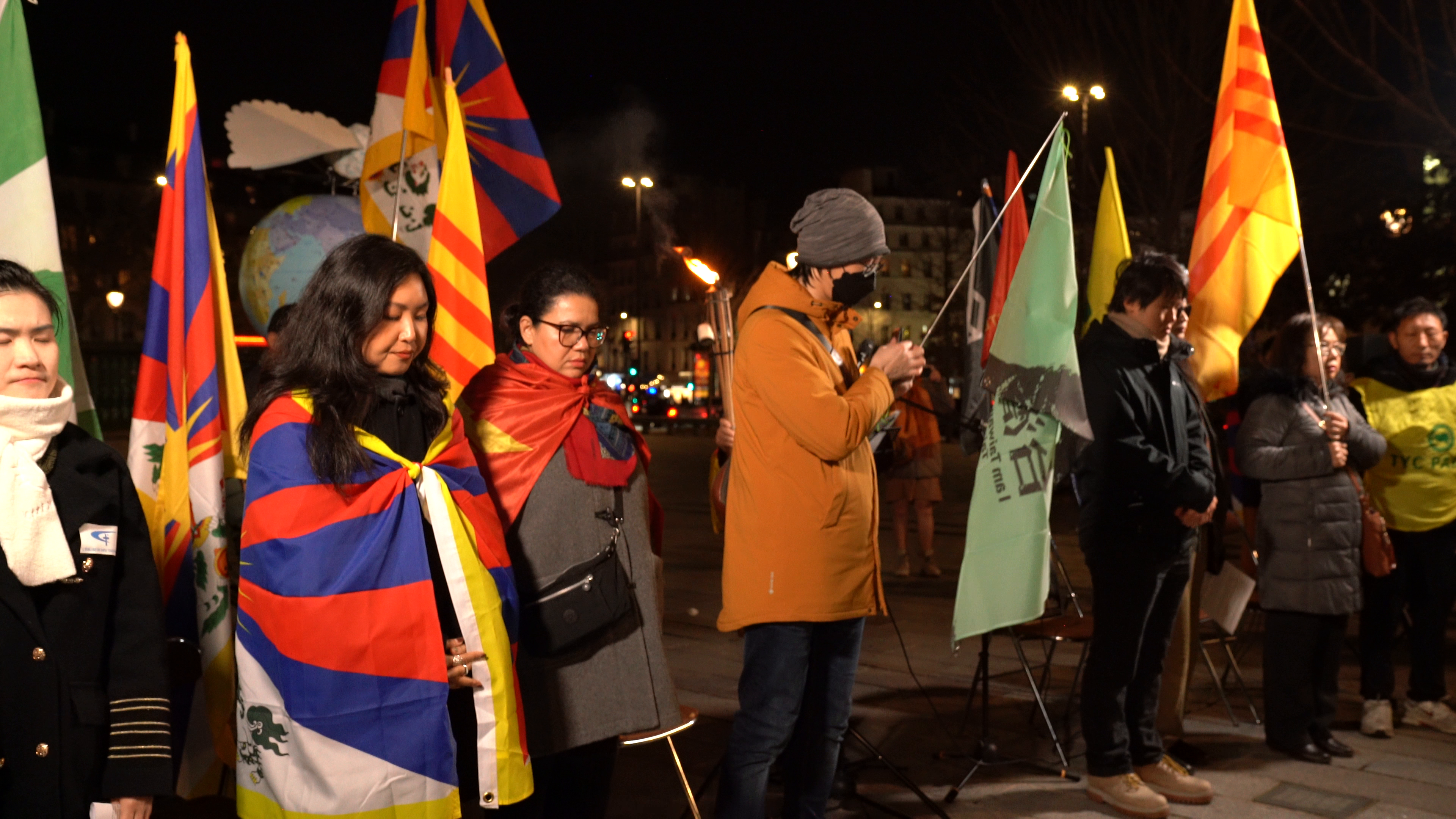
As a historic symbol of freedom, civil rights, and social struggle in France, Place de la Bastille was illuminated by torches on this winter night. The event was jointly initiated by Viet Tan and Students for Free Tibet France, drawing participation from Paris municipal council members, veterans of student movements, and people from diverse ethnic and religious backgrounds. Through public speeches, a torch relay, and symbolic acts of remembrance, participants emphasized that World Human Rights Day should not be merely a moment of commemoration, but a starting point for sustained action.
Multiple Groups Speak Out Together: Solidarity Across Borders
Compared with previous years, the number of organizations participating in this year’s event increased significantly. Groups from diverse regions and backgrounds—including Students for a Free Tibet, the Committee for Freedom in Hong Kong Foundation, the Uyghur Association of France, the Burmese Community of France, Vietnamese democracy organizations, and The Church of Almighty God (CAG)—stood side by side to speak out for persecuted communities worldwide.
This cross-border solidarity did not emerge by chance. Participants pointed out that systematic human rights violations under the authoritarian rule of the CCP are intensifying, with consequences that have long extended beyond China’s borders. In China, Uyghurs in Xinjiang have for years faced arbitrary detention, forced labor, and the erasure of their culture. In Hong Kong, since the enactment of the National Security Law, democratic space has sharply contracted, with press freedom and freedom of association severely undermined. In Tibet, religious and cultural freedoms continue to be suppressed, while the “boarding school policy” has forcibly separated children from their families and faith traditions, marginalizing Tibetan language and cultural expression. Meanwhile, human rights lawyers, dissidents, and civil society activists have been sentenced under vague charges such as “inciting subversion of state power,” as the space for free expression continues to shrink.
China’s Religious Freedom Crisis: The Plight of The Church of Almighty God
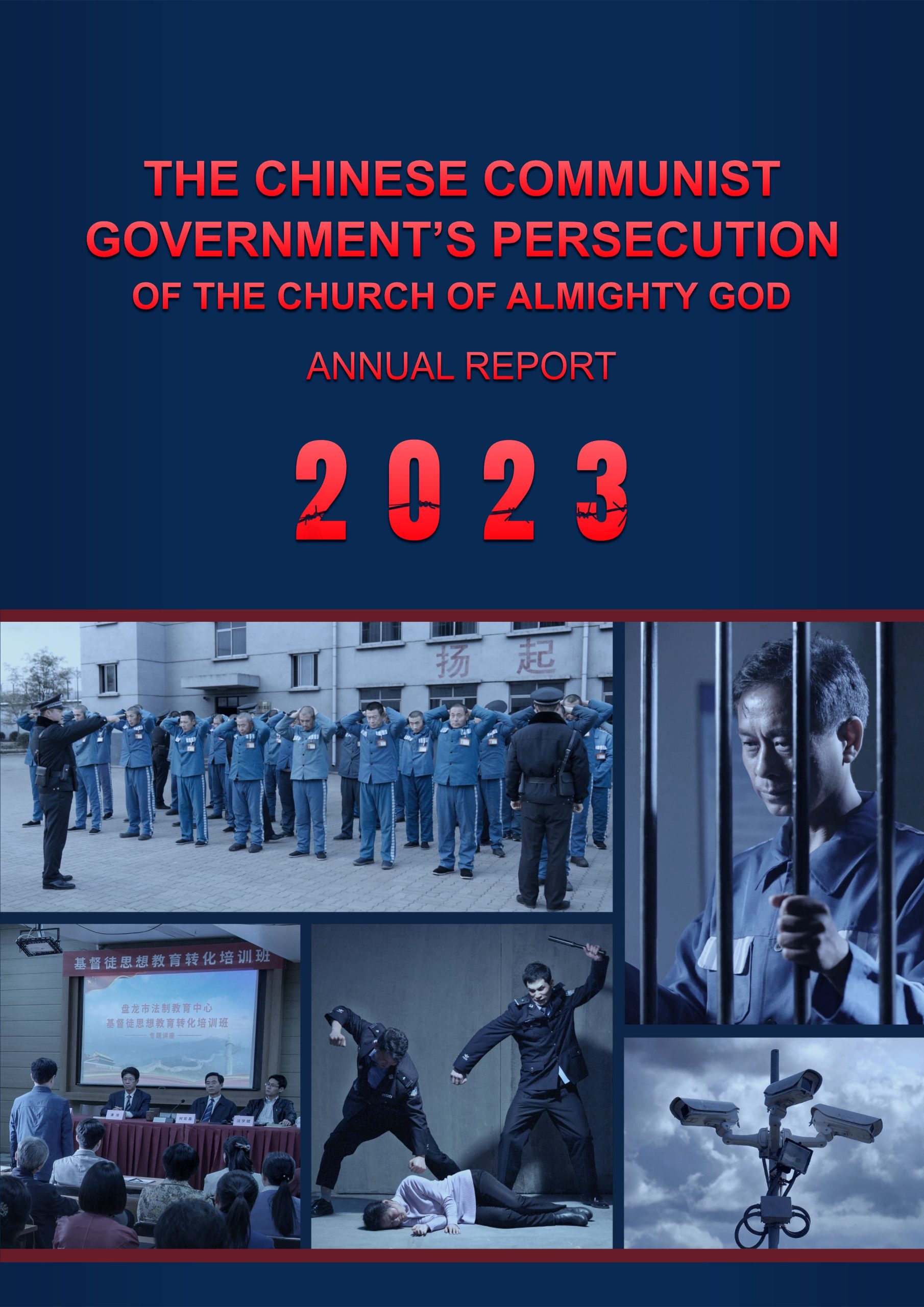
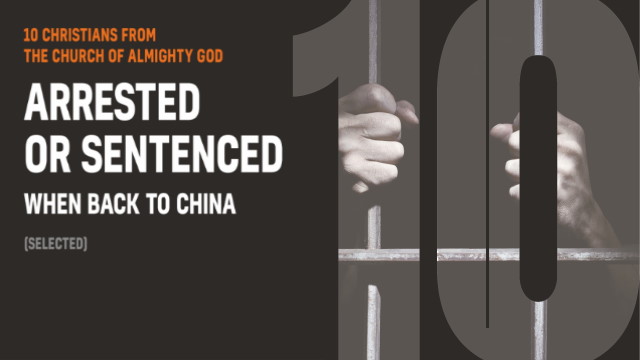
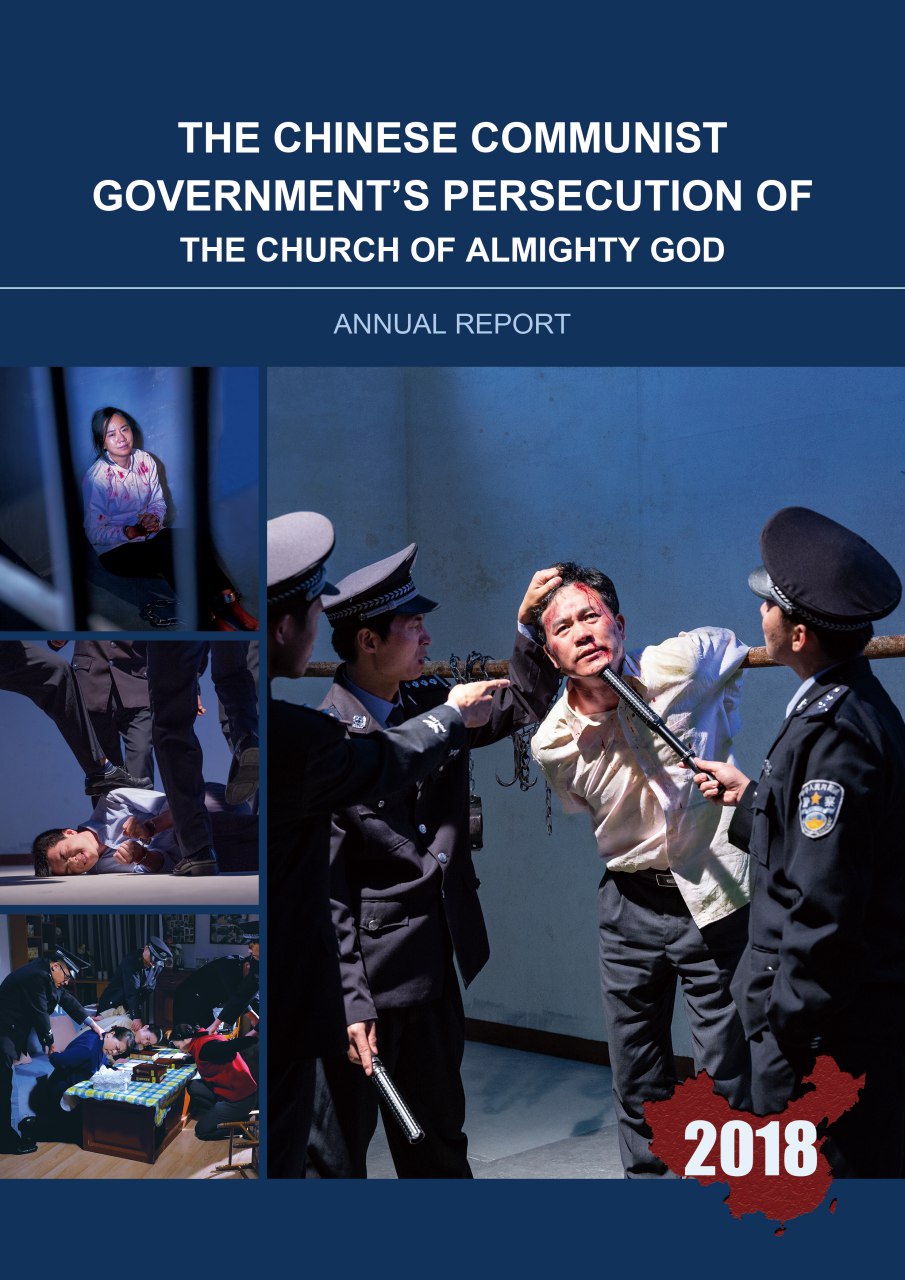
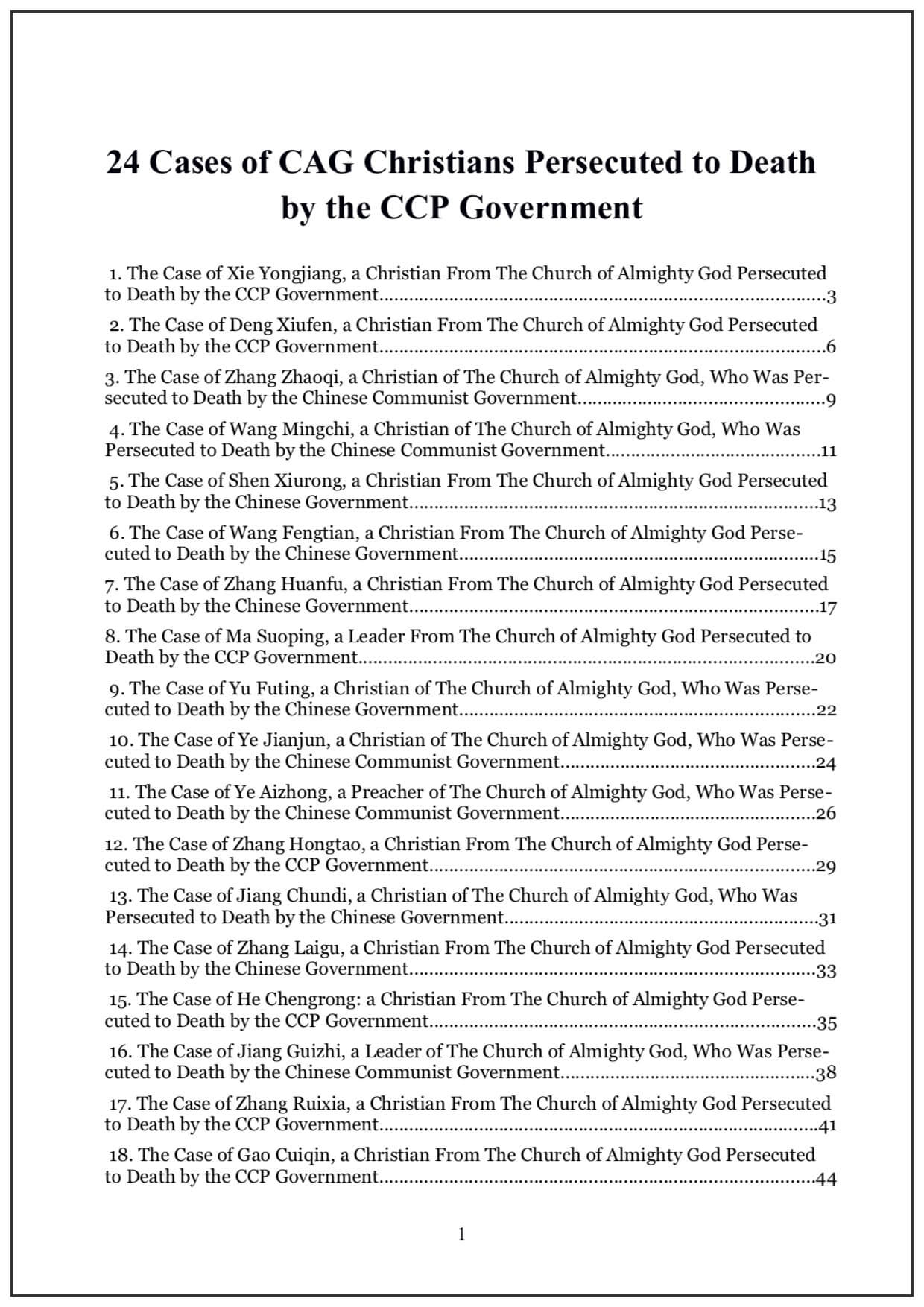
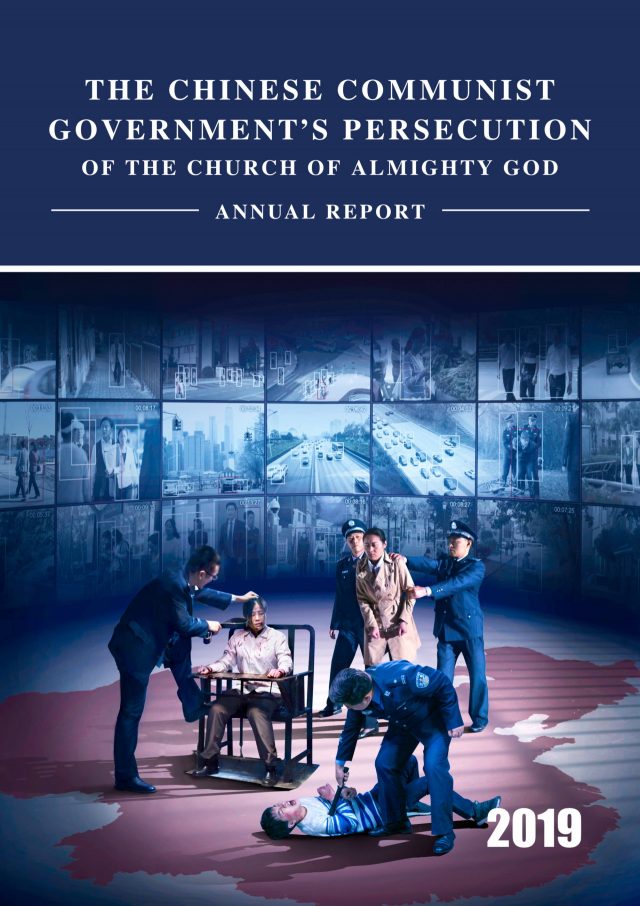
Among the many human rights issues raised, the situation of Christians from The Church of Almighty God drew widespread attention at the event. Multiple participants noted that the CAG has long been a primary target of repression by the Chinese government. In recent years, crackdowns against the Church have continued to intensify, with large numbers of believers subjected to close surveillance, arrest, and imprisonment. Some have been subjected to torture while in detention, and others have lost their lives as a result of persecution.
CAG representatives displayed panels documenting the demolition of churches and the persecution of believers in China, drawing the attention of many passersby. According to multiple publicly available sources, the systematic persecution faced by the CAG has become a typical case of the CCP’s repression of religious freedom in China.
Torch Relay and Declaration Reading: Carrying Forward the Spirit of the Bastille
One of the most symbolic moments of the event came when representatives from different organizations passed a torch from one to another. The flame flickered through the cold night, symbolizing the passing on of the ideals of freedom and human rights across communities and national borders.
In the opening remarks, the host stressed that human rights are not the privilege of a few, but universal rights belonging to all people, and must never be denied on the basis of political systems or ideologies. Representatives of various groups then took turns reading articles from the Universal Declaration of Human Rights. A representative of The Church of Almighty God read Article 18, underscoring the importance of freedom of thought, conscience, and religion. Following the readings, participants observed a one-minute silence in tribute to those who have been imprisoned, forced into exile, or lost their lives in the pursuit of freedom and human dignity.
From Commemoration to Action: Urging the International Community to Take Responsibility
In the remarks that followed, representatives from human rights organizations and the political sphere emphasized that the significance of World Human Rights Day should go beyond symbolism, and urge governments to translate declared values into concrete action.
Tenzi Chodun, a representative of Students for a Free Tibet, noted that the Tibetan people have long lived under systematic oppression, with their culture, religion, and environment facing severe threats. She emphasized that freedom and conscience are not so-called “Western values,” but are the core of universal human rights.
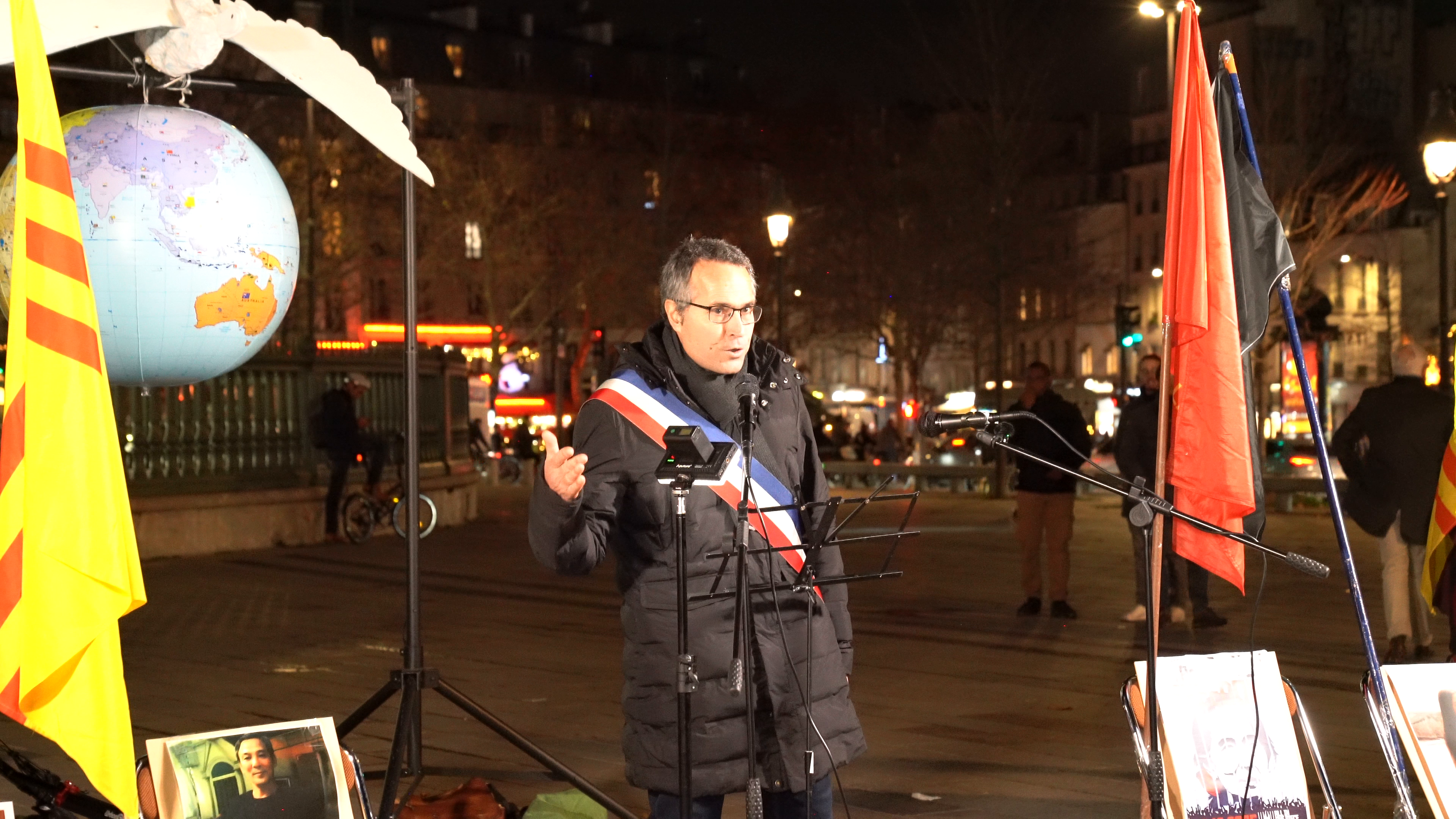
François Béchieau, Paris city councillor and deputy mayor of the 19th arrondissement, expressed his solidarity with oppressed communities including Tibetans, Uyghurs, Hong Kong democracy advocates, and Chinese Christians. He made specific reference to The Church of Almighty God, stating that although he is not a religious believer himself, he firmly supports freedom of religion. He emphasized that faith itself represents hope, and that everyone should have the right to choose their own beliefs.
Representatives from Myanmar, Vietnam, Taiwan, Hong Kong, and the Freedom Front also spoke in turn, addressing issues such as military coups, political prisoners, transnational repression, and democratic backsliding. They warned that the CCP’s authoritarian rule is exporting fear and repression beyond China’s borders, and urged democratic countries not to remain silent for economic or geopolitical reasons.
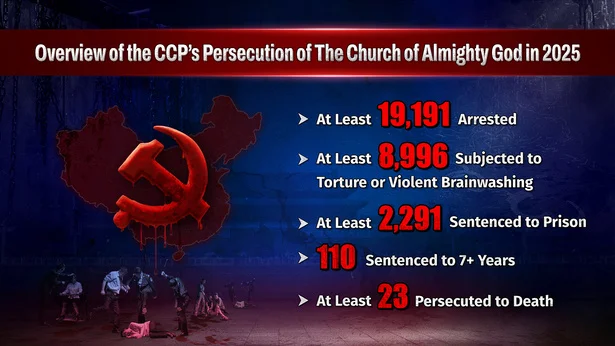
A Christian from The Church of Almighty God described the systematic persecution the Church has faced in China. She said that since the Church’s establishment, about 500,000 members have been arrested, with at least 307 believers persecuted to death. In 2024 alone, she said, more than 19,000 members were arrested, over 2,000 were sentenced to prison terms, and nearly 10,000 were subjected to torture or forced indoctrination. She called on the international community to promote independent investigative mechanisms and to maintain sustained attention to the state of religious freedom in China.
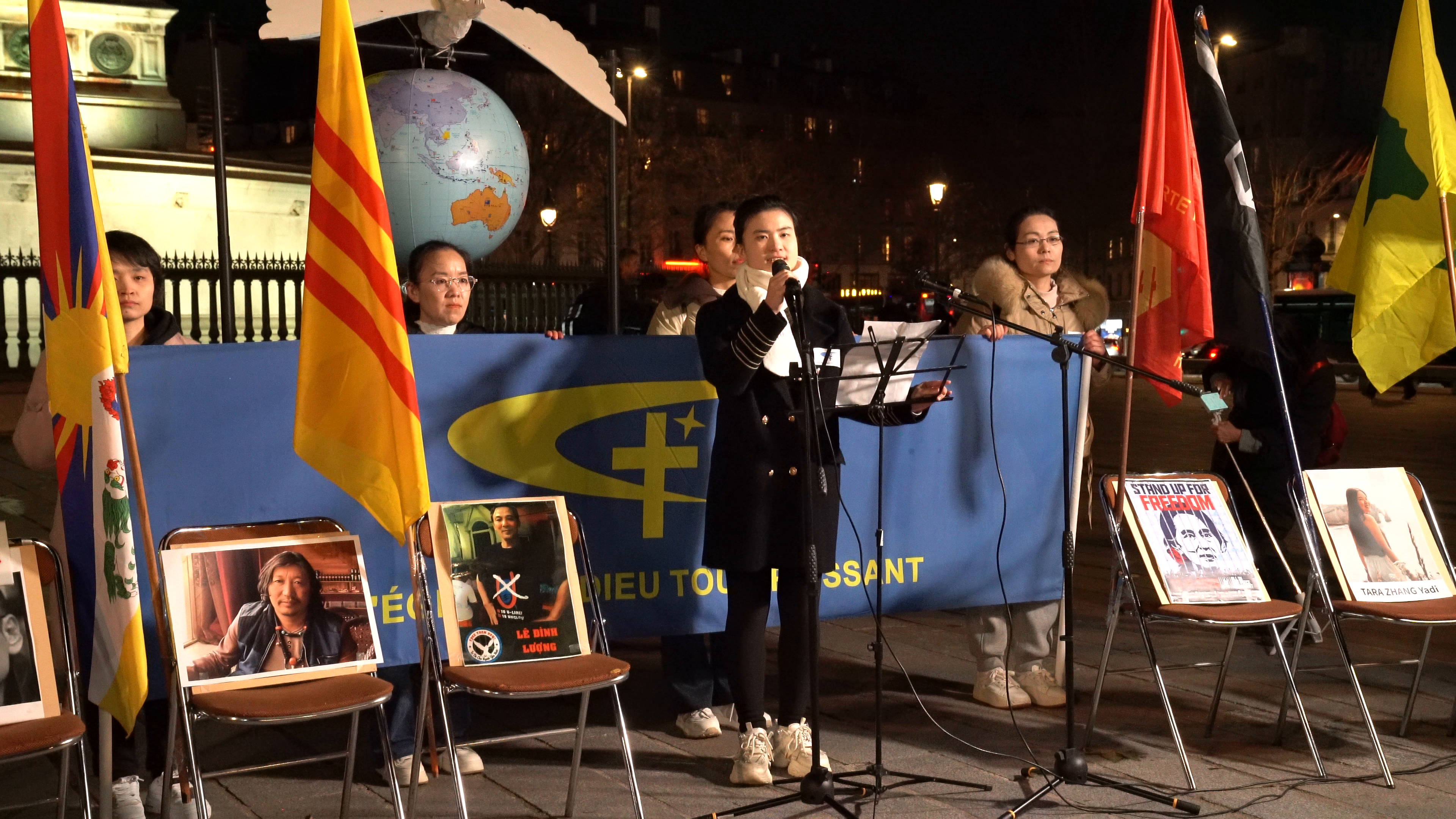
At the conclusion of her remarks, Luo Nuo shouted in French, “Give us back our human rights and freedom!” Christians from The Church of Almighty God and participants from other groups soon echoed her call, chanting “Liberté” three times as their voices echoing across Place de la Bastille.
Christians’ Firsthand Accounts: From Persecution to Forced Flight
During the event, several Christians from The Church of Almighty God were interviewed, sharing their experiences of arrest, surveillance, torture, and being forced to flee China because of their faith.
Christian Wang Yiping said the event made him keenly aware of the international community’s concern for human rights. In his view, the arrest, detention, and even deaths of Chinese Christians for adhering to their faith are not isolated cases, but a long-standing reality. He stressed that sustained international attention and advocacy are crucial to improving this situation.
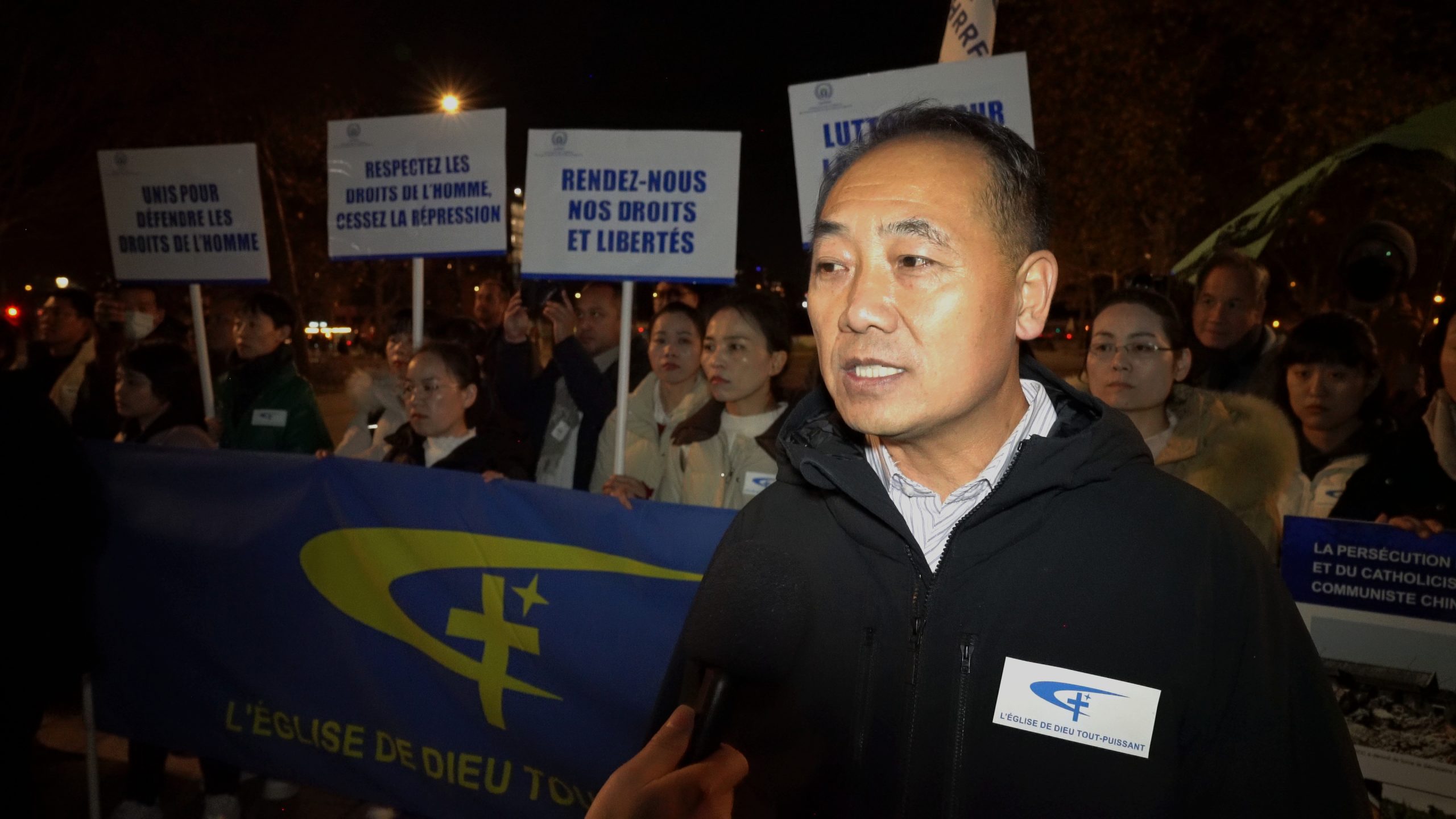
Speaking about her personal experience, Christian Su Xiao said that genuine freedom of religious belief does not exist in China. She recounted that in late 2024, several Christians from her church were arrested, and authorities obtained her personal information and repeatedly searched for her whereabouts, ultimately forcing her to leave China. After her departure, she learned that local police had installed surveillance equipment near her home and intimidated and pressured her family members. She said she hopes that by sharing her experience, the international community can gain a clearer understanding of the realities faced by Christians in China.
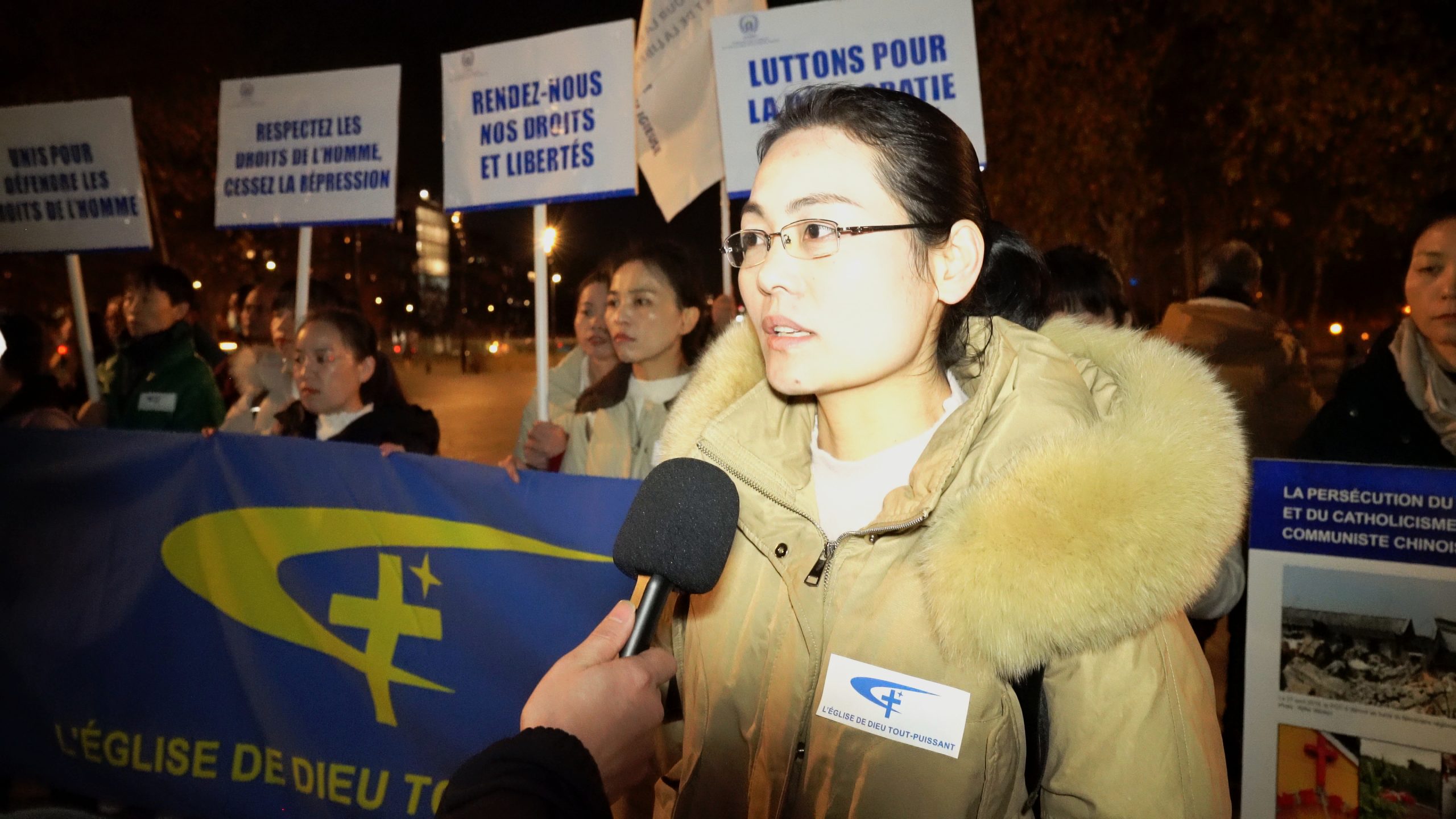
Christian Xiaomi said that participating in human rights activities is not only about speaking out for oneself, but also about urging international human rights bodies to confront the severe human rights situation in China and to help stop the systematic repression of religious groups. She believes that making information public and breaking through information barriers can help more people recognize the value of freedom and human rights.

Christian Su Xiao approached the issue from the perspective of the universality of human rights, stating that human rights are the most basic and inalienable rights of every individual. In China, however, religious believers are often subjected to long-term surveillance, restrictions on daily life, and in some cases forced separation from their families under a state-mandated atheist system. She explained that because of her identity as a Christian, it became increasingly difficult for her to continue living in China, and she ultimately came to France seeking asylum. By speaking out publicly, she said, she hopes to shed light on the real situation faced by Christians in China.

In the interview, Christian Li Yang spoke about his family’s long experience of repression because of their faith. He said his mother was repeatedly arrested by police for preaching the gospel and was later sentenced to prison, resulting in prolonged separation from her family. Li Yang also recounted being arrested during a church gathering and subjected to lengthy interrogations and beatings. He said that by speaking out publicly, he hopes to encourage greater attention to religious freedom and human rights conditions in China.

Human Rights Must Come Before Interests
In interviews related to the event, several political figures and human rights advocates stressed that human rights must not be marginalized in international relations. Paris City Councilor François Bescherlou noted that secularism does not mean denying religion, but rather safeguarding freedom of religion and conscience for all. He stated plainly that when democratic countries sidestep human rights issues for the sake of economic interests, they are, in effect, condoning persecution.
Tran Dung-Nghi, a leader of Viet Tan, also said that economic development cannot mask the reality of human rights backsliding, and that genuine progress must not be built on the suppression of conscience and faith. “Human rights diplomacy is not an outdated slogan,” he said. “It is a bottom line that must be upheld.”
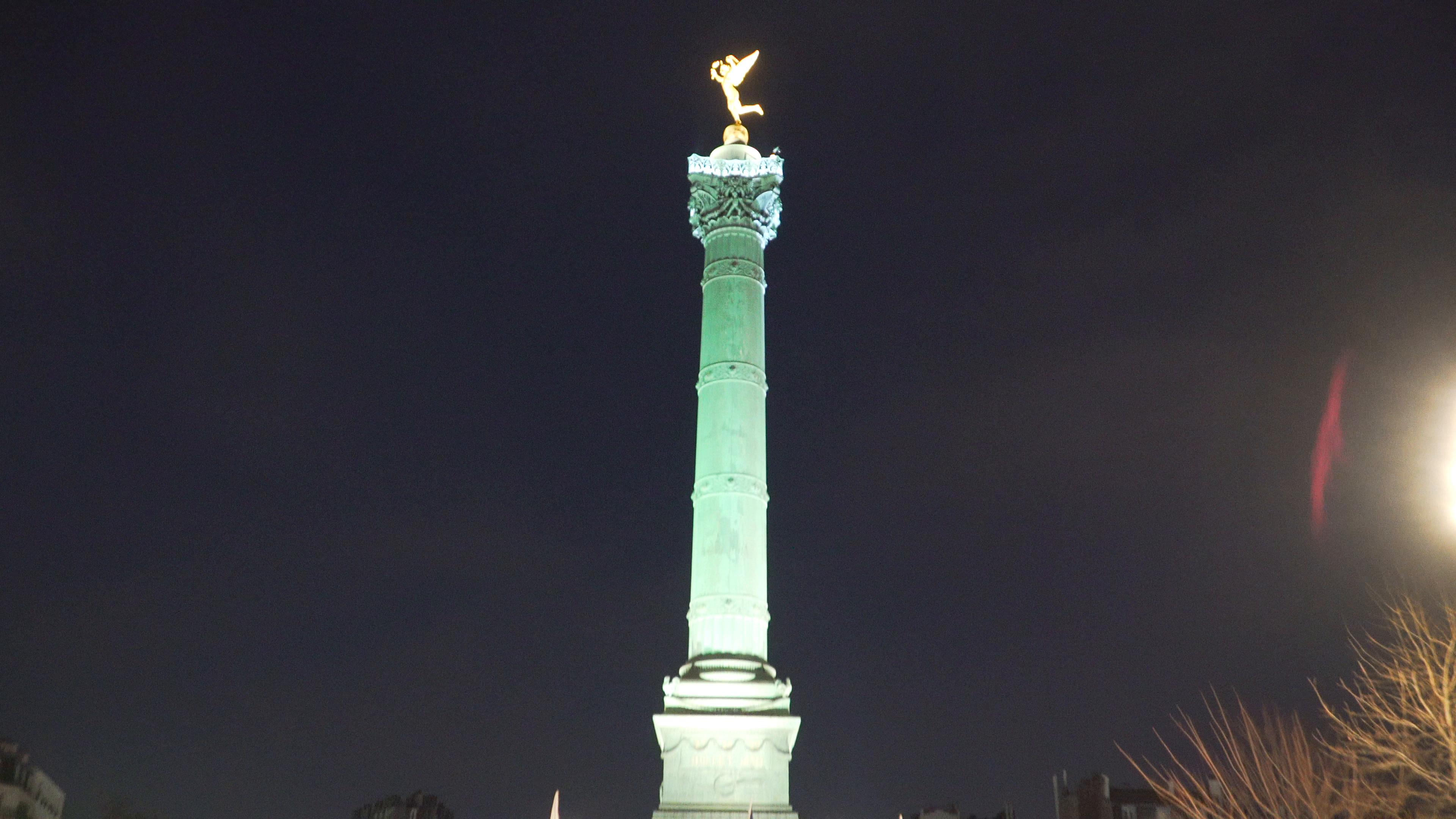
As the event drew to a close, representatives of the participating organizations gathered for a group photo in front of the July Column at Place de la Bastille. Organizers emphasized that amid growing global human rights challenges, sustained cooperation across countries and communities is essential to ensuring the voices of persecuted people are not silenced.
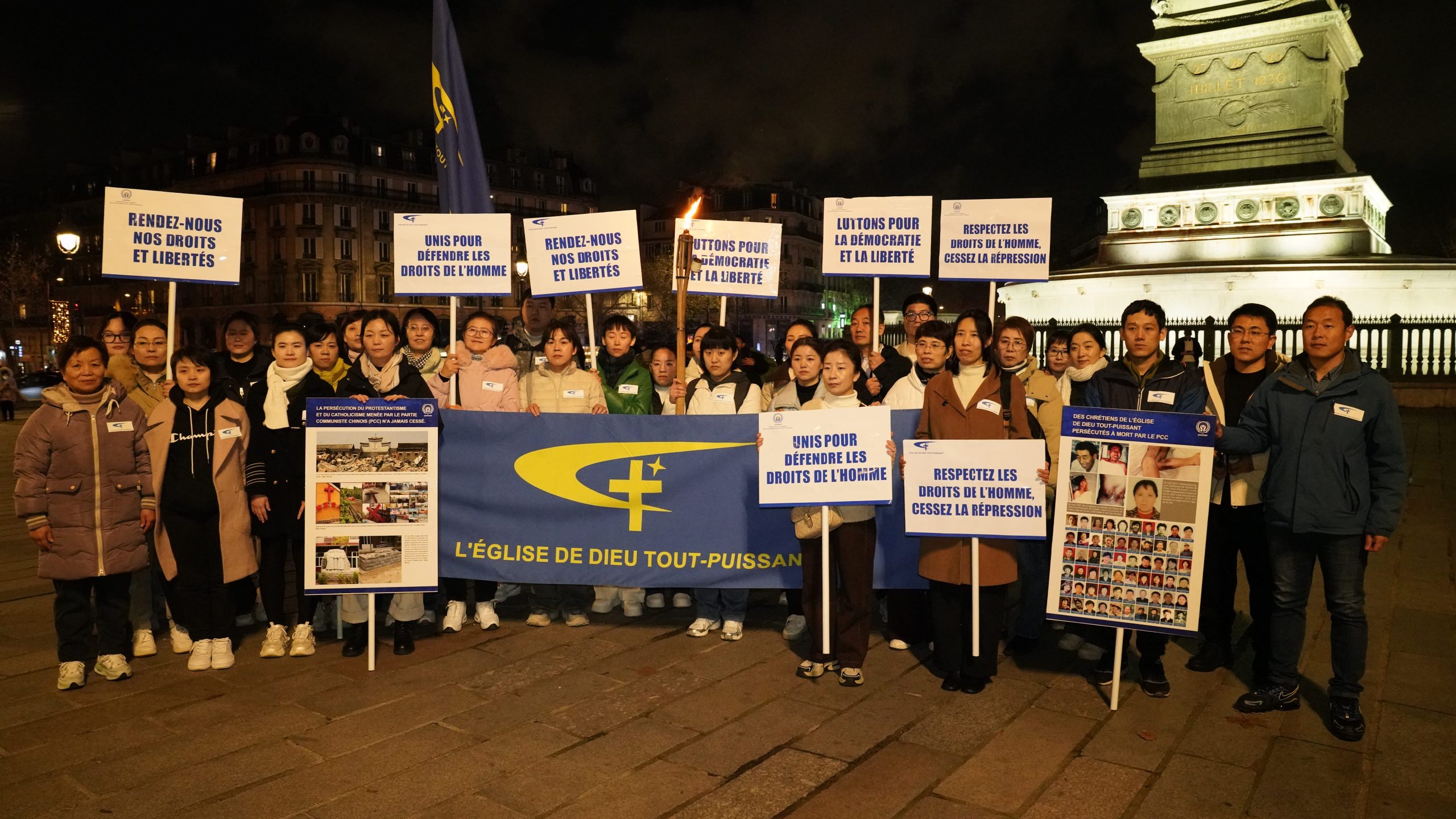
Torches continued to burn in the cold wind, banners fluttered, and chants echoed across the square. That night, Place de la Bastille was illuminated with an uncommon brightness—reflecting an unwavering commitment to freedom, human dignity, and human rights.
英语-20210131-GY-RGB-scaled.jpg)