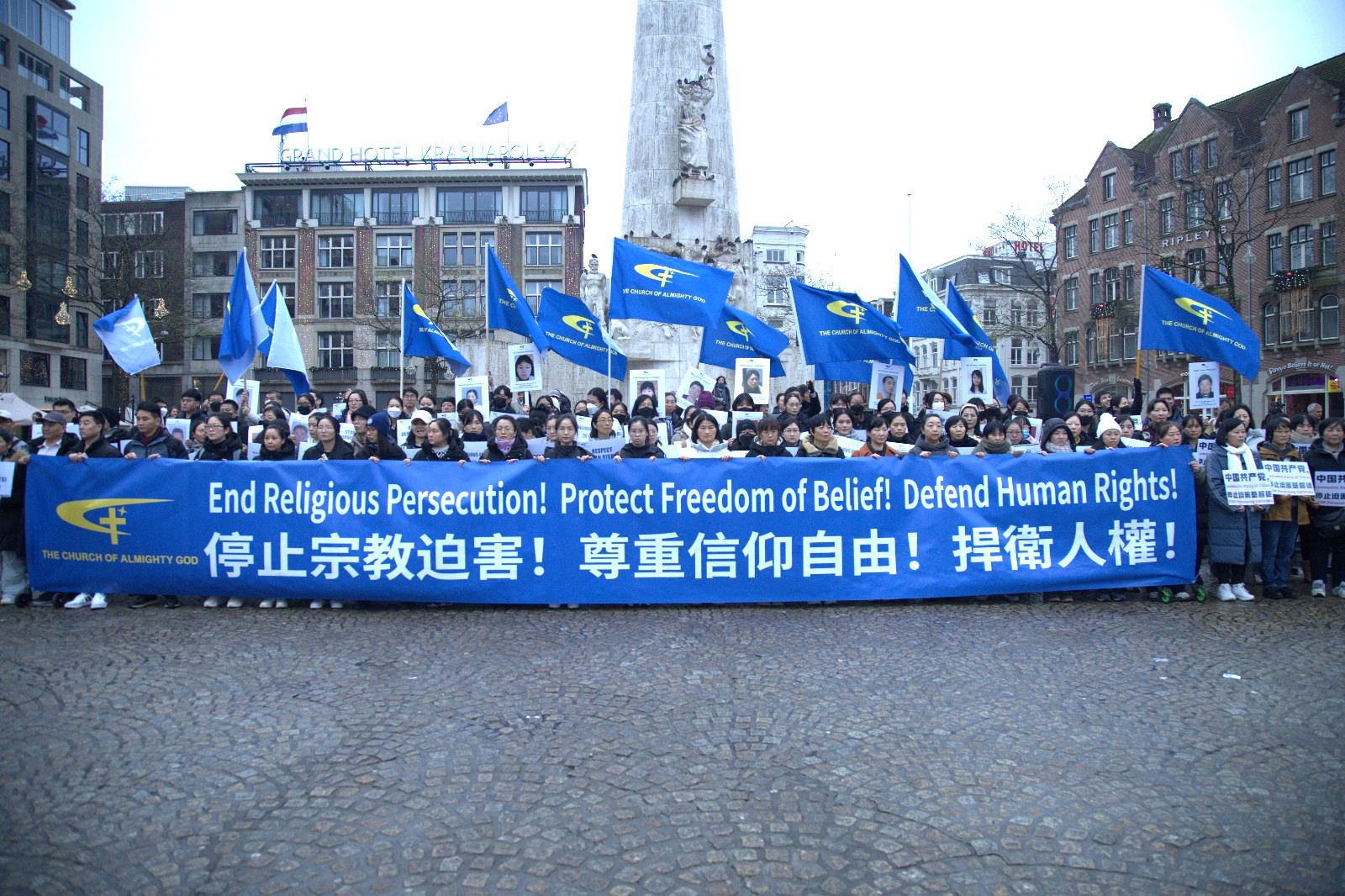
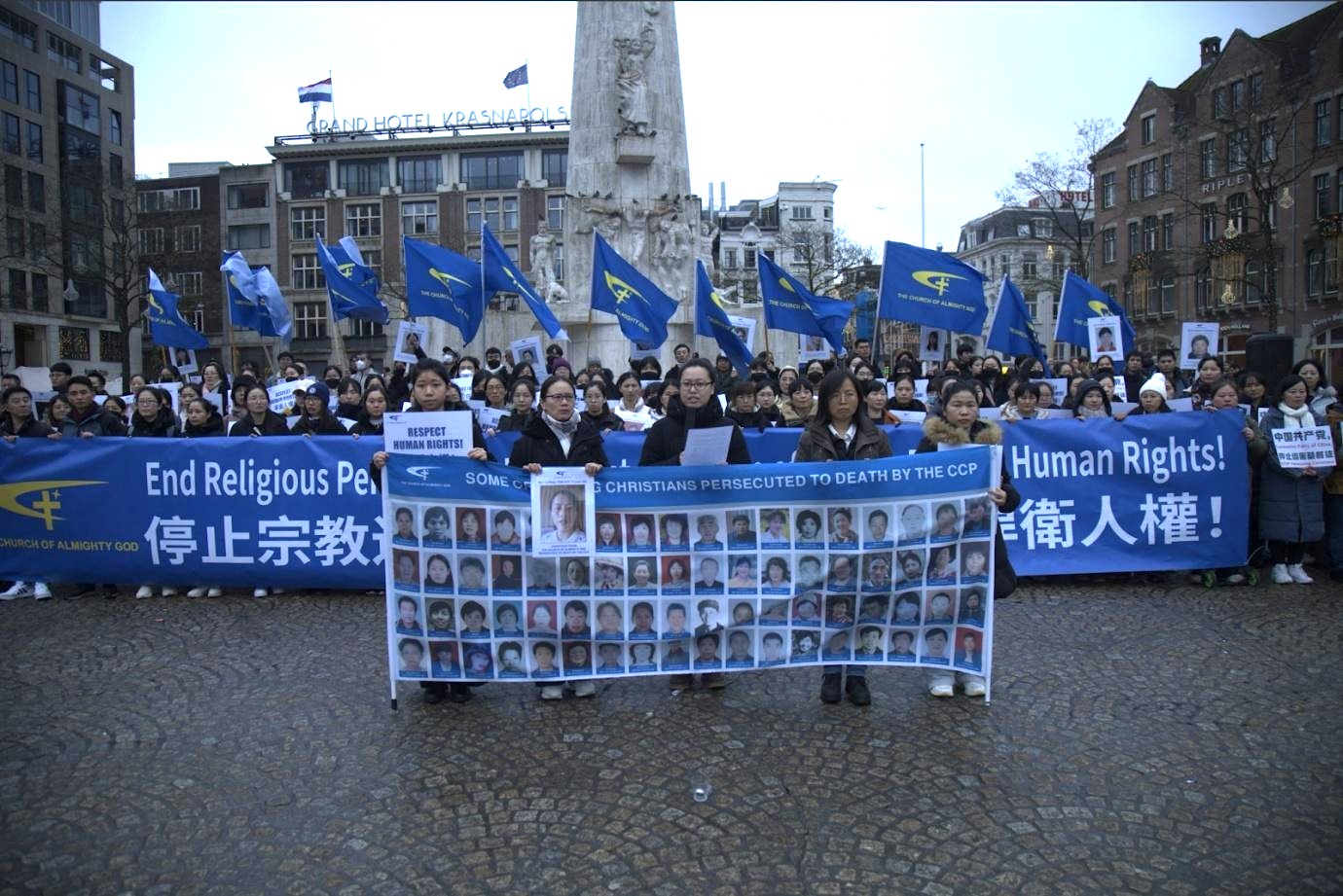
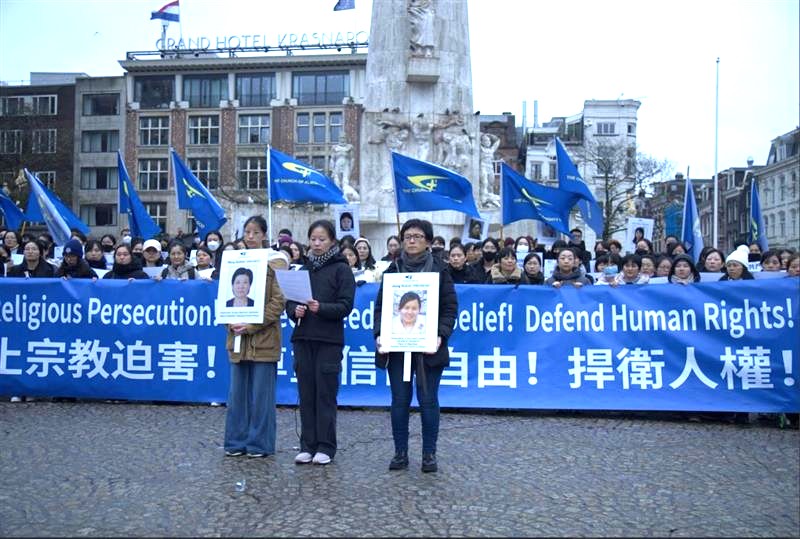
On December 7, 2025, three days before the 77th International Human Rights Day, more than 170 people gathered in front of the National Monument at Dam Square in Amsterdam, the Netherlands. They participated in a rally themed “Stop Religious Persecution, Respect Freedom of Belief, Defend Human Rights.”
Participants included Christians from house churches such as The Church of Almighty God and Zion Church, as well as democracy activists and human rights defenders. Through the rally, choral singing, and speeches, participants voiced their concern and worry over the state of religious freedom and human rights in China, and called on the international community to pay closer attention to China’s worsening human rights situation, especially the CCP’s persecution of religious groups.
Amsterdam’s National Monument, a landmark commemorating the victims of World War II, served not only as the backdrop to the rally, but also a symbol of the defense of freedom and human rights, adding profound symbolic meaning to the event.
A Moment of Silence for the Victims of the Hong Kong Fire, and Speaking Out for the Persecuted
At 1:30 p.m. local time, the rally was announced to start by Liu Feilong, a volunteer organizer for International Human Rights Day. Participants first observed a moment of silence in memory of the victims of the major fire at Wang Fuk Court in Hong Kong’s Tai Po District.
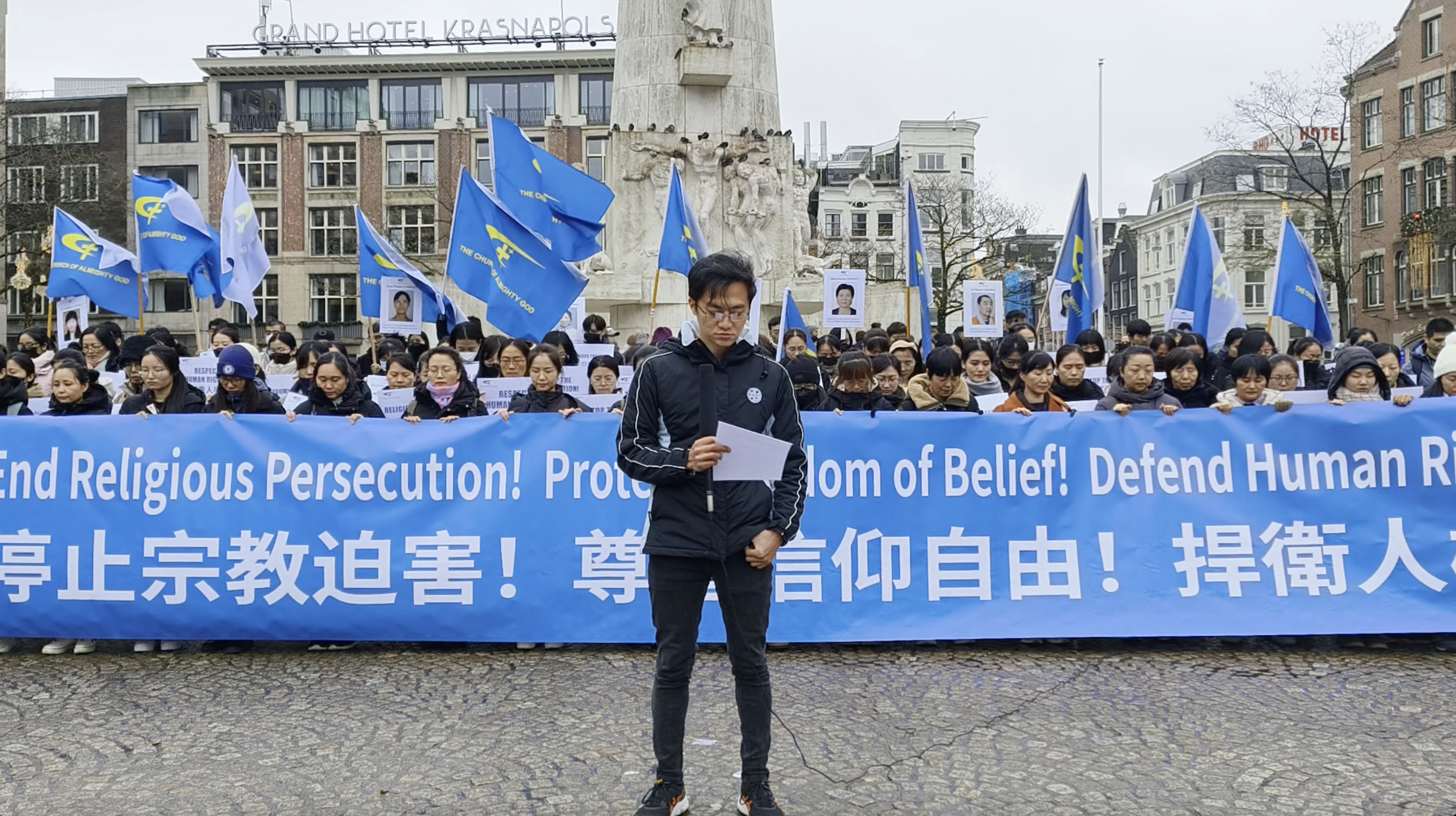
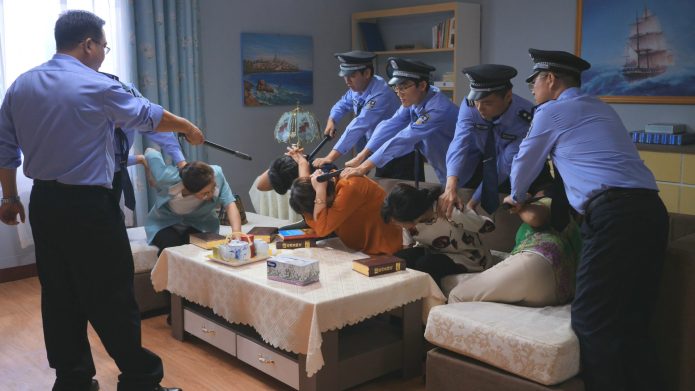
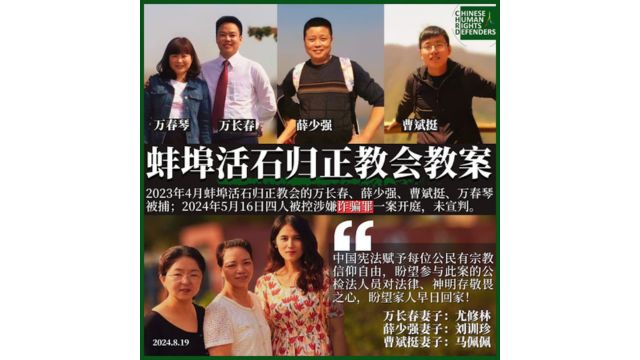
Next, the host, Erin, delivered the opening remarks in both Chinese and English. She briefly reviewed the significance of the Universal Declaration of Human Rights and outlined the current human rights situation in China. The host pointed out that multiple religious groups within China have long suffered cruel repression and persecution by the CCP. Ethnic minority groups, including Tibetans and Uyghurs, have been subjected to ethnic persecution. The human rights of democracy activists, such as human rights lawyers and dissidents, have also been trampled upon. Democratic freedom in Hong Kong has been destroyed, and the Chinese citizens’ freedom of expression has been completely stripped away. Erin further emphasized that in recent years, the CCP’s repression and persecution of The Church of Almighty God (CAG) has continued to escalate, with elderly members now also being targeted. In Zhejiang Province alone, from February to September 2025, nearly 100 elderly CAG Christians aged over 70 were arrested; the oldest was 93. Many were sent to “transformation centers” for forced indoctrination, and some were subjected to torture and abuse. She concluded by stressing that, given the ongoing infringement of religious freedom and basic rights in China, sustained attention from the international community is essential.
Following the host’s opening remarks, Christians from The Church of Almighty God sang a grand and stirring hymn titled “The Kingdom.” Their voices pierced the cold wind and echoed across Dam Square in Amsterdam. Moments later, the crowd chanted slogans in unison, and the atmosphere at the rally gradually steadily built. Afterward, representatives of Christians at the rally and human rights advocates delivered their remarks in turn.
Several CAG Christians took turns sharing their experiences of surveillance, arrest, and persecution in China.
Christian Li Xin spoke first. She described how she had been under police surveillance in China and the pressure she suffered. She said that, fearing police arrest, she was forced to move three times within just half a month, narrowly escaping arrest on several occasions. Amid frequent news of other Christians being arrested, she lived in constant fear.
She said: “Every day that I practiced my faith in China, I lived in constant fear and anxiety, with no peace of mind. Left with no other choice, I fled China and came overseas, separated from my family by thousands of miles. It is the CCP’s persecution that has prevented me from returning home.” In her remarks, she cited recent data on the persecution of The Church of Almighty God, noting that in 2024 alone, 19,053 Christians were arrested, 2,175 were sentenced, including 168 who received severe sentences of over seven years in prison, and at least 24 died as a result of persecution. She emphasized: “Faith is not politics. Prayer is not subversion.”
Next, Christian Zhu Juan stated that while the CCP outwardly claims to guarantee freedom of belief, it continues to suppress religious groups and dissidents internally. She recalled: “One day in June 2012, I was arrested by the CCP simply for my belief in Almighty God. The police slapped me across the face and kicked me hard in the abdomen. When one sister asked to use the restroom, they refused and humiliated her, forcing her to urinate in her pants. I was only 24 years old at the time. It left me with deep emotional scars and immense fear.”
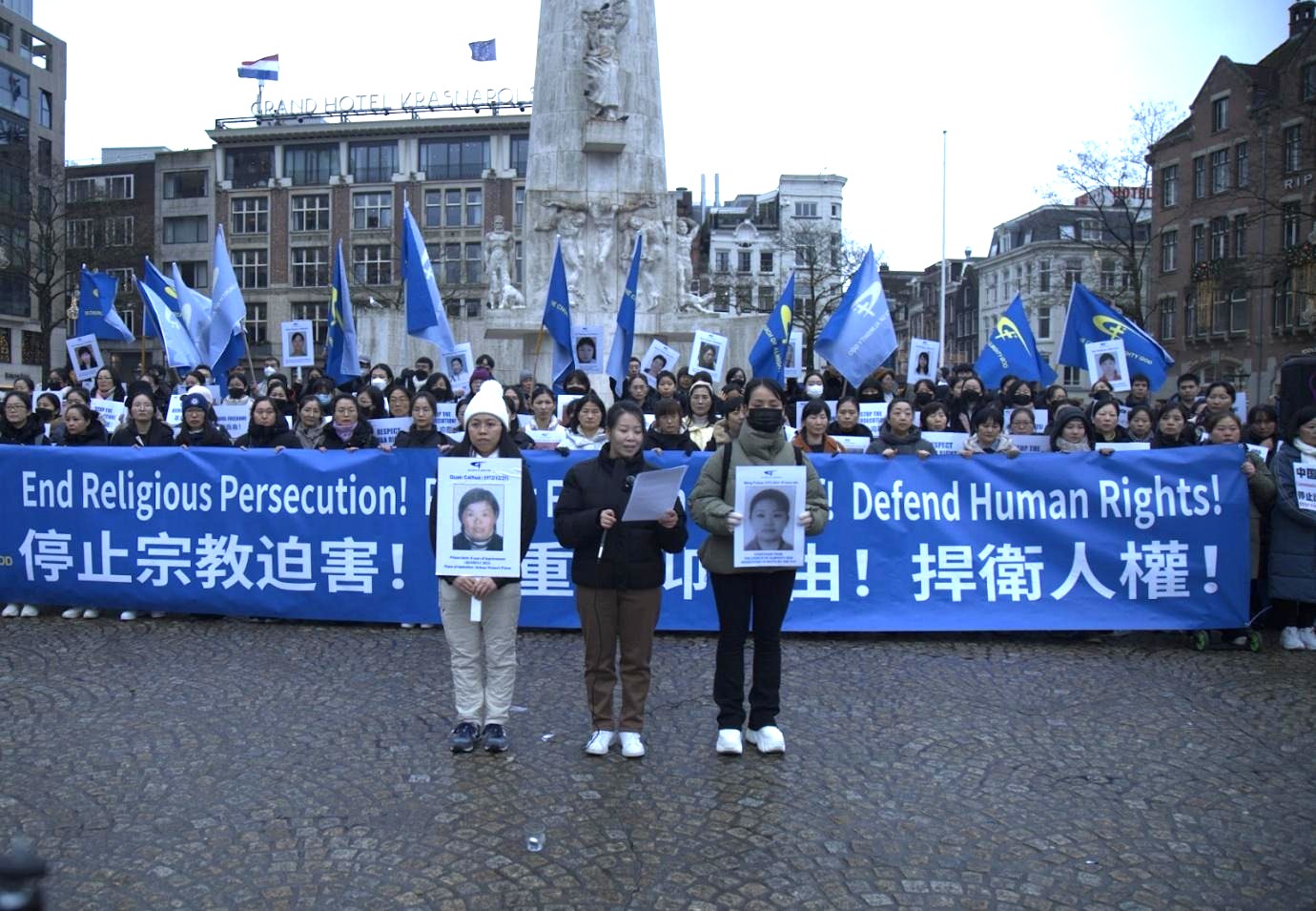
Zhu Juan also spoke about the ordeal of a church sister close to her. The sister was dismissed from her public-sector position and fined more than 100,000 RMB (about 15,000 USD) simply for her faith. Her husband was arrested for believing in Almighty God and his whereabouts remain unknown. According to available data, between 2011 and 2024, at least 490,000 CAG Christians from The Church of Almighty God were arrested. She said: “Countless Christians and dissidents have been monitored, arrested, sentenced, and imprisoned by the CCP. Many have died as a result of persecution, and many others have been forced to leave their homes. Such persecution has inflicted both psychological and physical suffering on us.”
The third Christian speaker, Shi Junxia, shared her experiences in mainland China. Between 2023 and 2024, The Church of Almighty God in her city was subjected to six coordinated mass arrest operations, during which nearly 400 CAG Christians were taken into custody. On February 13, 2023 alone, at least 40 members of her church were arrested in a single day. To evade capture, Shi Junxia was forced to move seven times in just one month. One of her co-workers, Sister Xiaomu, was taken away by police during a church gathering, while Shi narrowly escaped arrest only because she happened to be out on an errand that day. Afterward, she was forced to hide in the homes of church brothers and sisters and could not go out freely. She said: “In order to arrest Christians, the CCP has installed high-definition surveillance cameras throughout streets and neighborhoods. When I became ill, I did not dare go to the hospital. Because of the CCP’s persecution, we do not even have the freedom to step outside and breathe fresh air.”
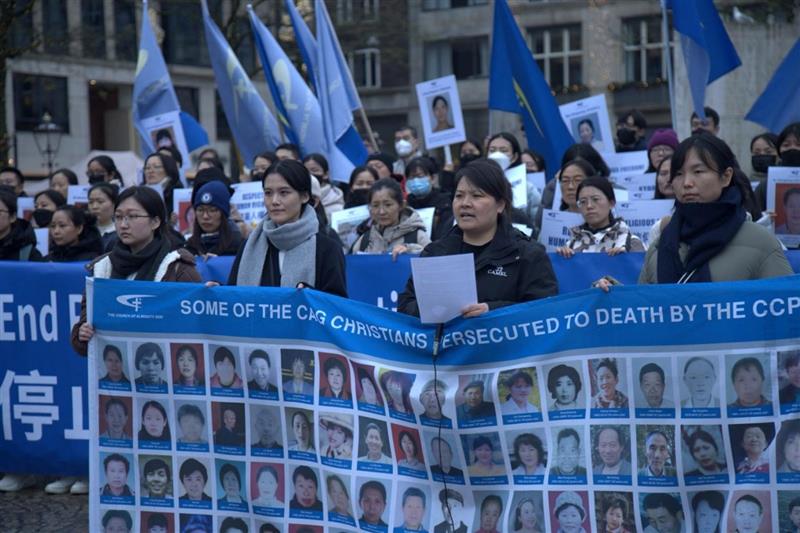
She continued: “What was even more deeply distressing was that during an arrest in August 2024, police injected Brother Yang with drugs in an attempt to force him to inform on other Christians in the church, leaving him severely mentally disoriented. He endured extreme suffering and was left in a state worse than death. During that period, news of brothers and sisters being arrested kept reaching me. Living under such intense pressure, I was often jolted awake by nightmares.”
The fourth speaker was Christian Wang Mengting. She shared that she has followed her family in believing in Almighty God since childhood, and that through God’s words she found direction in life. However, under China’s harsh environment for belief, many Christians have been left homeless and displaced. In 2018, she fled overseas, where she can freely read God’s words and watch church videos online, and finally breathe the air of freedom.
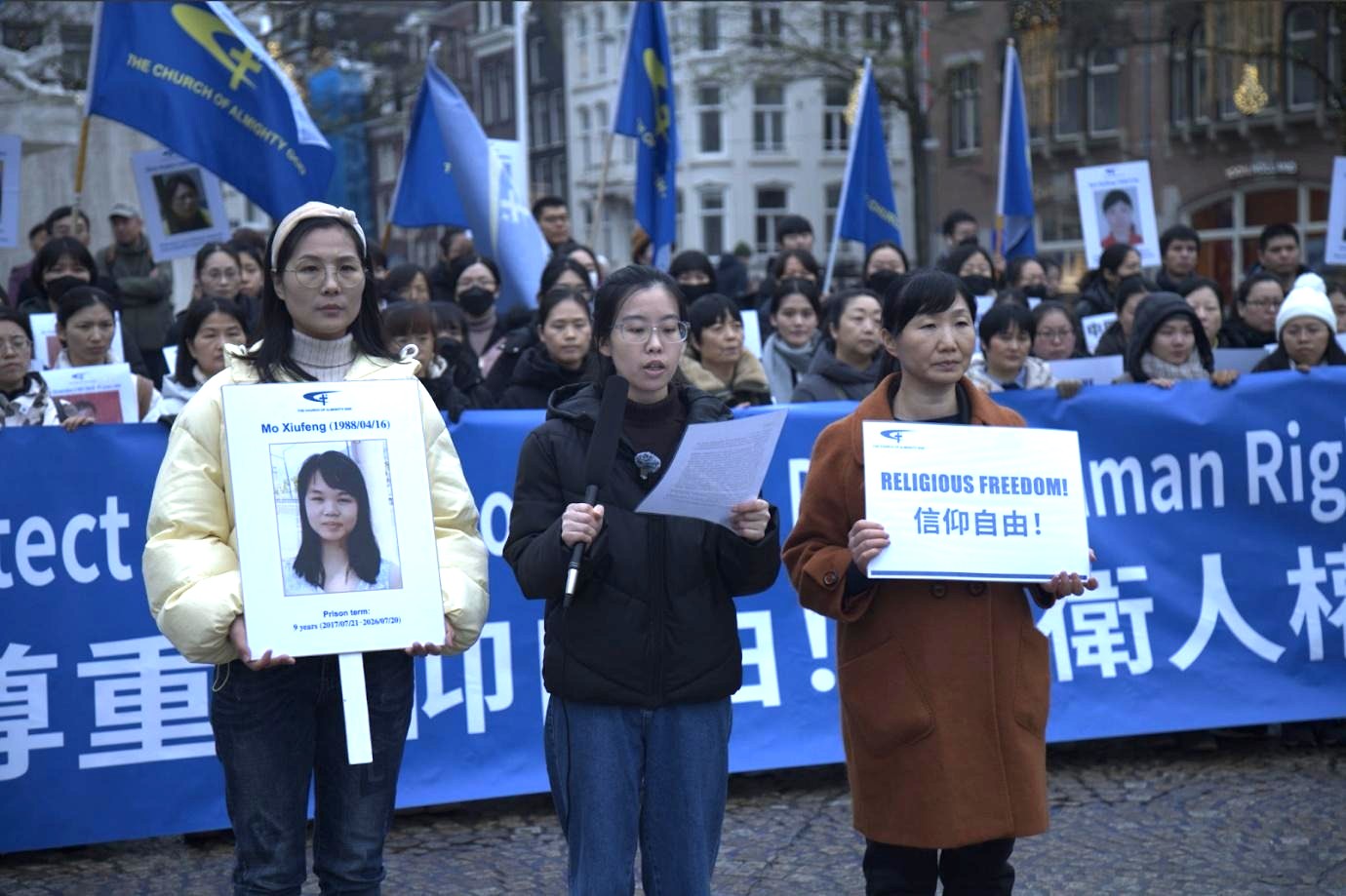
However, when thinking of her family still in China and other Christians who remain there, Wang Mengting felt heavy-hearted. She said: “In 2024 alone, nearly 20,000 members of The Church of Almighty God were arrested. The CCP spares no one—from minors to elderly over seventy years old. In the eyes of the CCP, the lives of Christians are treated as no more valuable than those of ants, and can be abused or destroyed at will.” She also spoke about the CCP’s transnational repression: “The CCP’s long arm has already extended overseas. It monitors and tracks Christians abroad, spreads baseless rumors to smear our church, and even pressures foreign governments in other countries, attempting to forcibly repatriate us to China so the persecution can continue.”
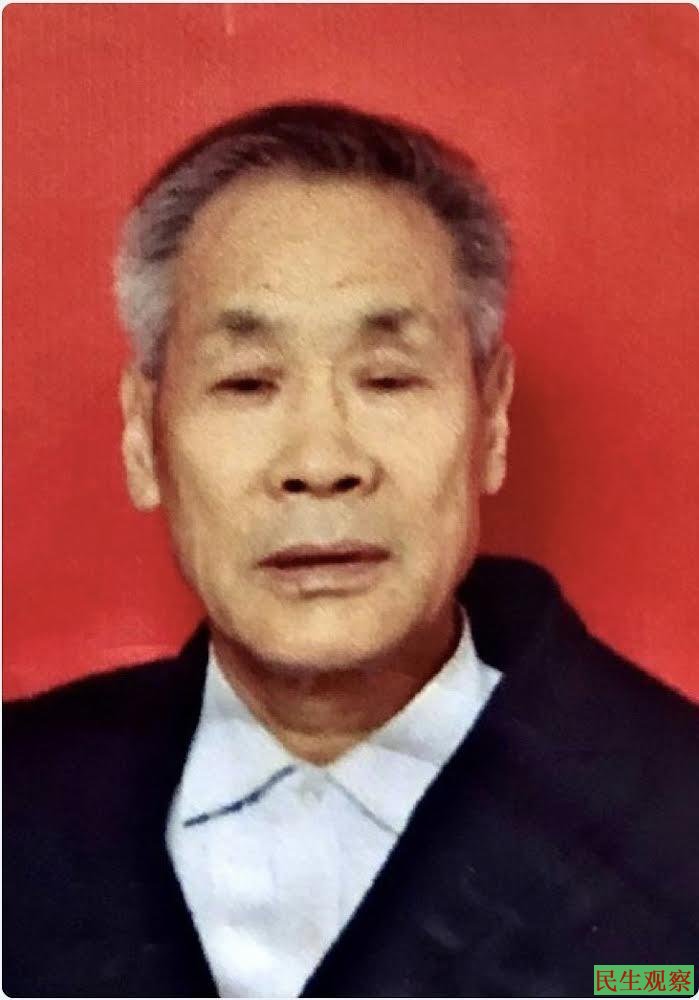
The fifth speaker was Christian Liu Haixia. She stated that although she is now living in the Netherlands—a country that protects freedom of religion—her heart remains heavy. “Here, people are free to gather and express their faith. But in China, Christians are persecuted by the CCP simply for believing in God. They are arrested, sentenced, and even subjected to torture.” She specifically referred to photographs displayed at the site, showing Christians who died as a result of persecution by the CCP.
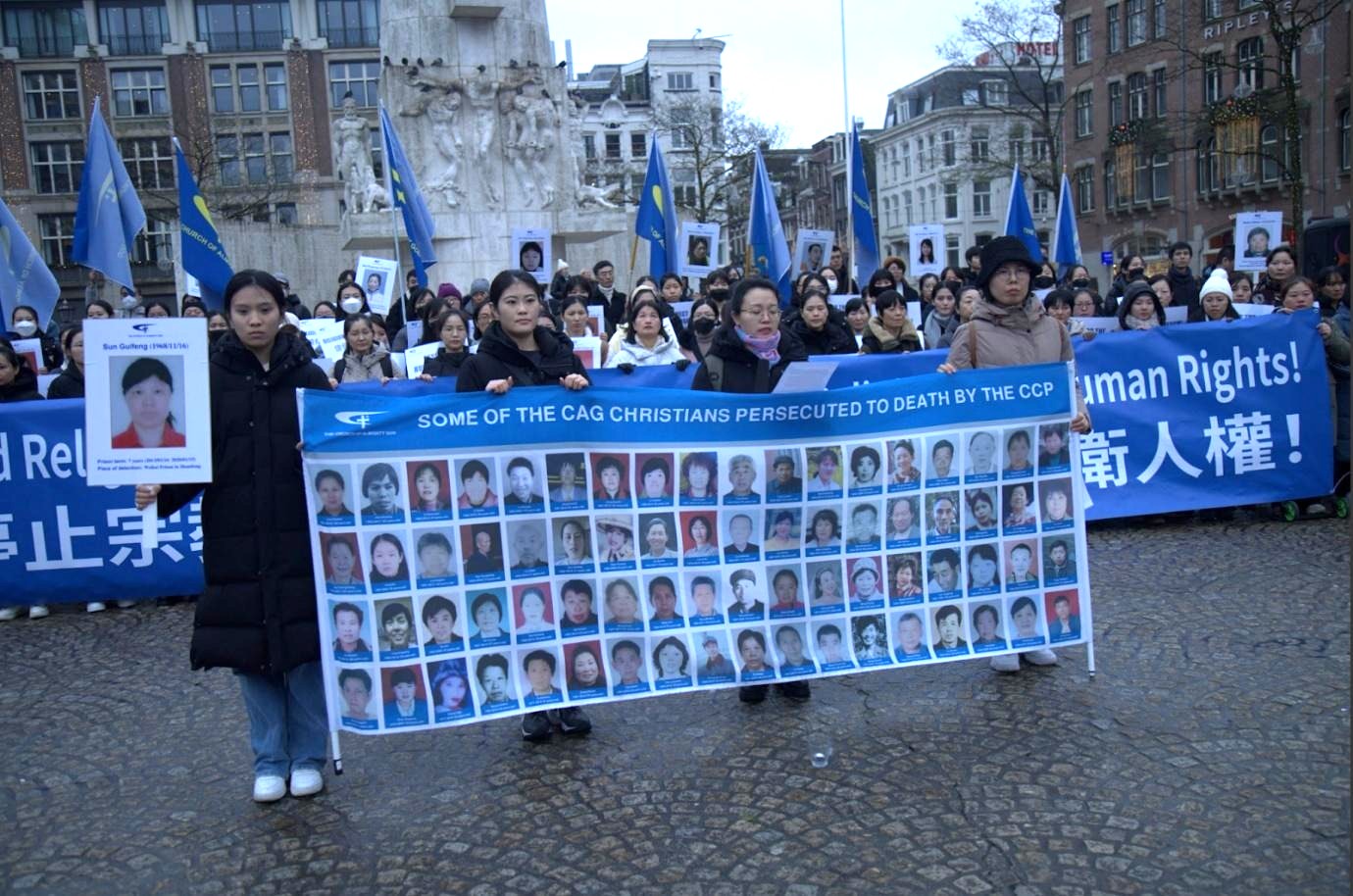
Liu Haixia also recalled what she went through back in China. In just two months, more than twenty Christians around her were arrested, and she herself narrowly escaped arrest on several occasions. To evade pursuit, she was forced to move constantly, at times hiding in duck sheds and mountain caves, often jolted awake by nightmares. “That period was filled with fear, loneliness, and helplessness,” she recalled. In the end, she was forced to leave her hometown and her family—never even getting the chance to see her father one last time. Speaking of her life after arriving overseas, she added: “For the first time, I truly experienced the release that comes with freedom of belief and expression. I can openly believe in God, gather freely, and speak the truth without fear of being silenced.” However, she also pointed out that even abroad, the CCP’s transnational repression and persecution continues to cast a shadow. She said: “Defending human rights and freedom is not just an idea; it requires action.”
The sixth speaker was Christian Li Huijun. She has followed her mother in believing in Almighty God since childhood. Her mother was targeted for sharing the gospel with a colleague. She was not only summoned for a talk by her work-unit leader, but also threatened with being reported to the authorities. These experiences cast a deep shadow over Li Huijun’s young heart.
After entering university, Li Huijun found that her school disseminated anti-Christian propaganda and encouraged students to monitor one another and report anyone who believed in God. She cautiously shared the gospel with classmates, yet was still discovered by the school authorities. The school demanded that she sign a pledge renouncing her faith, threatening to report her to the police if she refused. In order to remain faithful to her belief, Li Huijun was forced to leave the university. Soon afterward, she was pursued by the CCP, and her family was also implicated.
Li Huijun said: “The CCP installed surveillance cameras outside my home to monitor my family. They frequently harassed them and threatened that if they could not locate me, their jobs would also be affected. To evade the CCP’s pursuit, I had no choice but to leave my hometown and my family behind and flee to Europe alone.” She went on to emphasize: “Why does the CCP hate Christians so much? The CCP is an atheist party. It denies the existence of God and does not allow the Chinese people to believe in God. It fears that if people worship God and no longer hold a place in their hearts for the Communist Party, it will be unable to control the Chinese people or maintain its rule.
The seventh speaker was Christian Sang Ningning. She pointed out in her speech that International Human Rights Day serves to remind all nations to uphold human rights, as well as the dignity and fundamental freedoms that every person deserves. However, in China, even the most basic freedom of belief cannot be guaranteed.
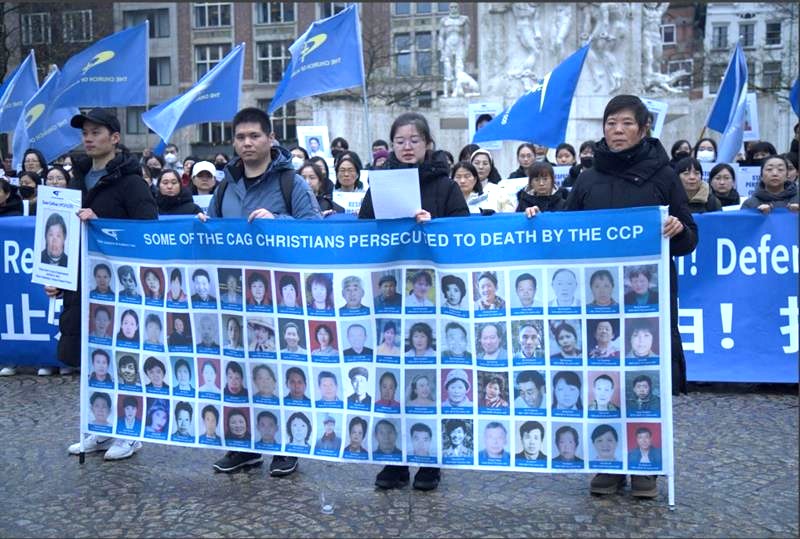
Recalling her experience of practicing her faith in China, Sang Ningning said that many brothers and sisters around her were arrested for believing in God. In order to force them to renounce their faith or betray other Christians, police routinely subjected them to extremely brutal torture during interrogations. She herself was also targeted by the CCP police for arrest and lived under constant surveillance and tracking. To evade capture, she was forced to move frequently, sometimes changing locations three times in a single day, and even disguised herself by switching wigs, hats, and clothing to conceal her identity. While walking down the street, the sound of police sirens filled her with intense fear, as she felt she could be arrested at any moment. She said, “That period of my life felt like a nightmare. Even now, when I think back on it, it still fills me with fear.”
Sang Ningning stated that after arriving in Europe, she experienced what freedom of belief means for the first time. Yet in China, a large number of Christians continue to be arrested, interrogated, and imprisoned. Some are subjected to torture, and others have even lost their lives. She said: “As long as the CCP’s totalitarian tyranny exists, Christians in China will have no human rights at all.”
The eighth speaker was ChristianWang Ye. Speaking in English, she described how CCP persecution has torn her family apart, leaving them unable to reunite and her father’s whereabouts still unknown. She said: “My parents and I all believe in Almighty God. In 2014, because of persecution by the CCP, I was forced to leave my country. To avoid arrest, I had to move constantly and live in hiding across multiple provinces and cities.
Eventually, I was forced to give up my graduate studies and flee overseas. My parents later also left China. After escaping abroad, in order to protect our relatives in China from being implicated, we have not dared to initiate contact with them for many years.”
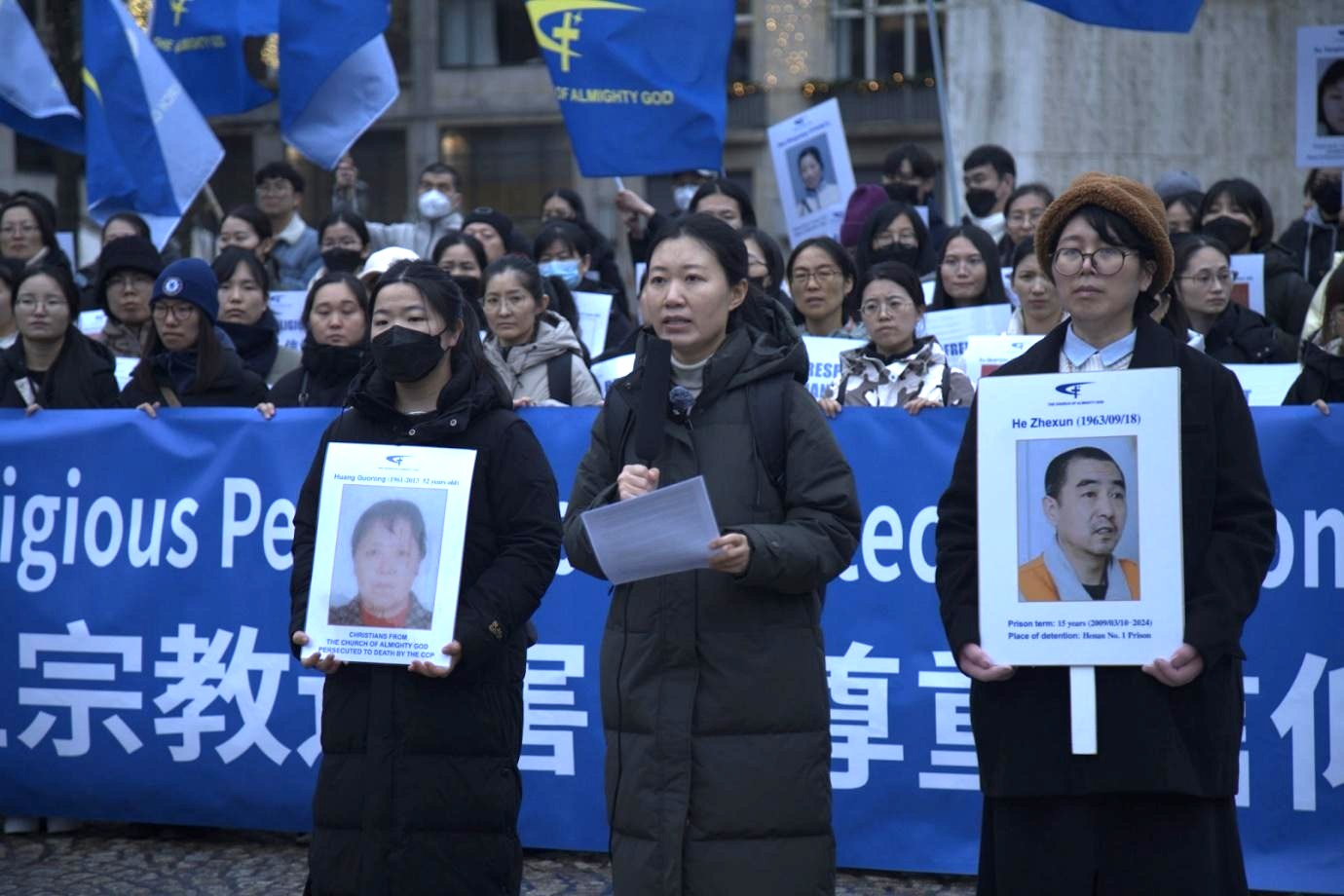
Wang Ye continued: “Then, in 2019, my dad got seriously sick and needed urgent treatment. But after several years abroad, we simply could not afford the high medical cost. We had no choice but to take a huge risk and send him back to China for treatment. We never thought this return would be the start of our painful separation.” She went on: “Soon after he went back, my dad disappeared. We didn’t hear any message from him until 2023, when he managed to send us a letter. He wrote that the CCP had arrested and questioned him, because he had previously participated overseas in the filming of a gospel film related to our faith. Even though the police knew he was gravely ill at the time, he was still put in handcuffs and leg shackles and forced to sit on a ‘tiger bench.’ The police repeatedly pressured him to name other believers featured in the film and disclose their names and addresses. They also persistently questioned him about my mother’s and my location, and even demanded that he fabricate a critical illness notice to lure us back to China—but my father refused.
Later, as his condition worsened, the police—fearing he might die in custody—released him under what they called ‘execution outside prison’. However, he was required to report to the police station every week and they constantly monitored him.” She said that her father was later taken into custody again and his whereabouts remain unknown; it is unclear whether he is alive or dead.
Wang Ye mentioned that the root cause of the persecution of Christians in China lies in the dictatorial rule of the CCP, an atheist party. She stated that, in order to achieve its goal of “one-party dominance” and ensuring that the “red regime never changes its color,” the CCP has for years carried out systematic persecution against religious groups, dissidents, and human rights defenders. She denounced the CCP as a thoroughly evil organization.
Democracy Advocates and Human Rights Defenders: From Religious Persecution to a Broader Human Rights Crisis
In the latter part of the rally, several dissidents and human rights defenders from China spoke in succession, broadening the focus from religious persecution to wider human rights issues.
Wei Zhijian, from Guangxi, is a member of the Overseas Committee of the China Democracy Party. He began by speaking about the reality of the Guangxi “Autonomous Region.” He revealed that the CCP’s so-called autonomy is, in fact, “political colonization.” Guangxi’s cultural identity and autonomous rights have been systematically eroded, and the transmission of religious traditions and ethnic languages has been subjected to multiple forms of suppression. He noted that many people in Guangxi have been imprisoned, tortured, or even forcibly disappeared simply for defending the vulnerable, speaking the truth, or holding fast to their beliefs.
Sui Xiaobo, another member of the Overseas Committee of the China Democracy Party, highlighted the cases of Xu Zhiyong, Gao Zhisheng, Ding Jiaxi, and other human rights defenders who have been detained, forcibly disappeared, or deprived of their freedom simply for speaking the truth and standing for justice. He called on the international community to pay close attention to their plight.
Xing Songlin, a human rights defender from Henan Province, singled out and criticized Chen Quanguo, the senior official responsible for implementing repression policies in Xinjiang. He stated:“The international community must expand sanctions—not only against the executioners, but also against those who give the orders.”
Human rights advocates Yue San, Jiang Hong, Jiang Peikun, and She Yang, from the provinces of Henan, Fujian, Heilongjiang, and Guangdong, took the floor one after another. Drawing on issues including environmental disasters, labor rights activism, the arrest of human rights defenders, the demographic and economic crisis in Northeast China, the forced suppression of local culture and the Cantonese language in Guangdong, and the cover-up surrounding the Wang Fuk Court fire in Hong Kong, they painted a stark picture of the rapidly deteriorating human rights situation in China today.
Between speeches, resounding, unified chants rang out across the square: “Respect human rights! Freedom of belief! Stop the persecution!” “Faith is not a crime! Worship is not a crime!”
During the rally, many passersby stopped to watch, and some of them, along with volunteers and Christians on site, were interviewed.
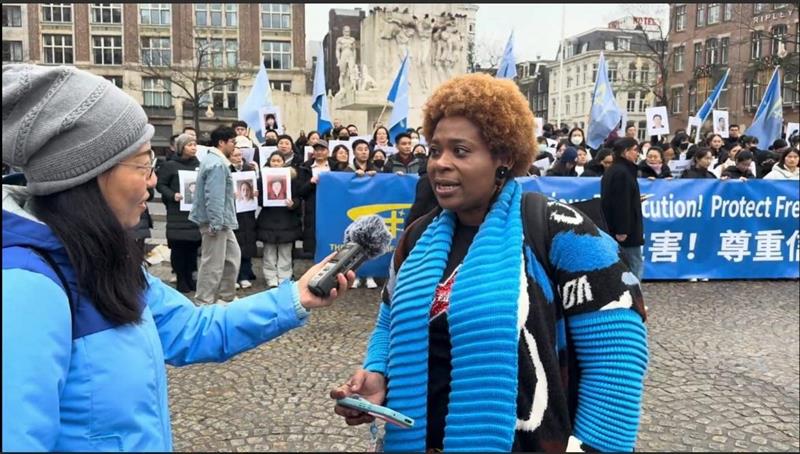
One passerby who agreed to be interviewed said she felt deeply saddened by the persecution Christians face under the CCP. She said: “I feel like people have freedom of their own religion. They should have the right to have their own freedom of their own religion. It’s very sad to hear this, because I myself am a Christian. I just came from church, and I just came on the Damn Square, and I hear this. It really breaks my heart.”
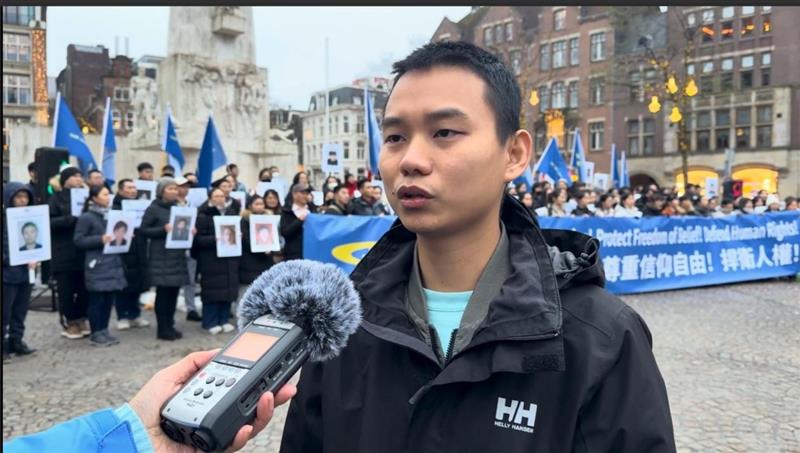
Several human rights advocates and Christians from China were also interviewed, sharing their reflections and takeaways from participating in the rally.
Jiang Peikun, a dissident and human rights defender from Guangdong now living in the Netherlands, spoke in an interview about his views on the CCP. He said, “The CCP does not represent the Chinese people. It is a tyrannical apparatus that exists to preserve one-party rule. It uses fear and propaganda to control the public and violates universal values. I hope more people will come to understand that the CCP is not China.”
When asked how Western governments and the public should respond to the CCP’s transnational repression, Jiang Peikun said that Western governments should strengthen legislation, shut down the CCP’s overseas police stations, and protect dissidents from surveillance and coercive “abductions.”
Jiang Peikun also said: “I am participating in this protest today because I have personally experienced and witnessed the CCP’s persecution. As a native of Guangdong, I cannot remain silent. I want to speak out for victims like the Uyghurs, Tibetans, Hongkongers, and Christians, and to oppose the CCP’s tyranny. The significance of participating in actions like this lies in uniting overseas communities, exposing the CCP’s crimes, and awakening the international community.”

Liu Feilong said that he learned about the persecution of The Church of Almighty God through reports from multiple media outlets. In his view, the CCP’s persecution of the Church violates universal values and constitutes a serious infringement of fundamental human rights.
Speaking about his participation in the rally, Liu Feilong said: “Everyone who came here today to take part in this rally has shown great courage. Standing together like this is extremely important.” He noted that the CCP is likely to harass or pressure participants’ families who remain in China. But for that very reason, he said, it is even more necessary to continue speaking out to the international community. He called for unity: “Whether we are inside China or overseas, we should stand together and encourage one another. This is not something the CCP can dictate or suppress.”
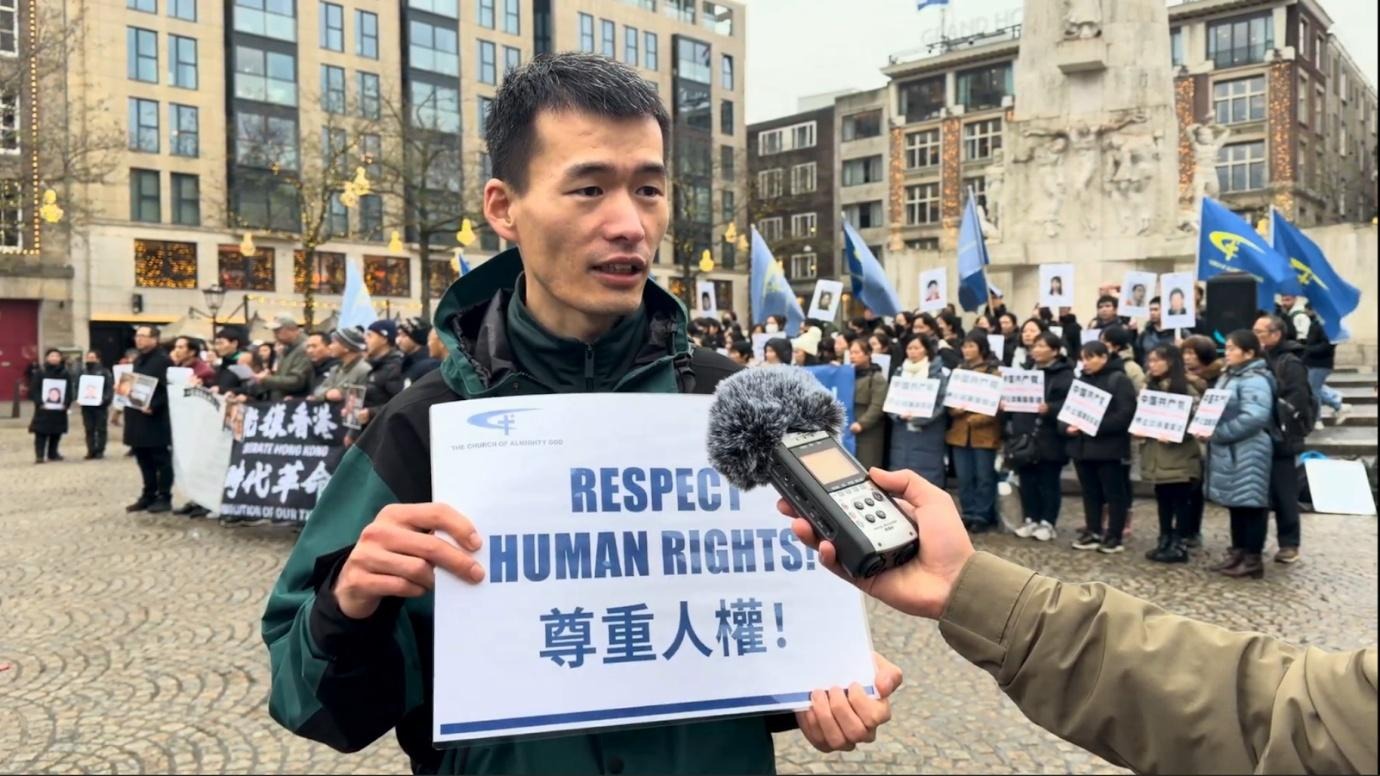
Christian Xiang Yang said that he took part in the event to denounce the CCP and to speak out for Christians who continue to face persecution in China. He shared that he himself had been persecuted for his faith and had narrowly escaped arrest on one occasion. He said: “There is no genuine freedom of belief in China. The CCP’s violations of religious freedom and fundamental human rights are deeply shocking.”
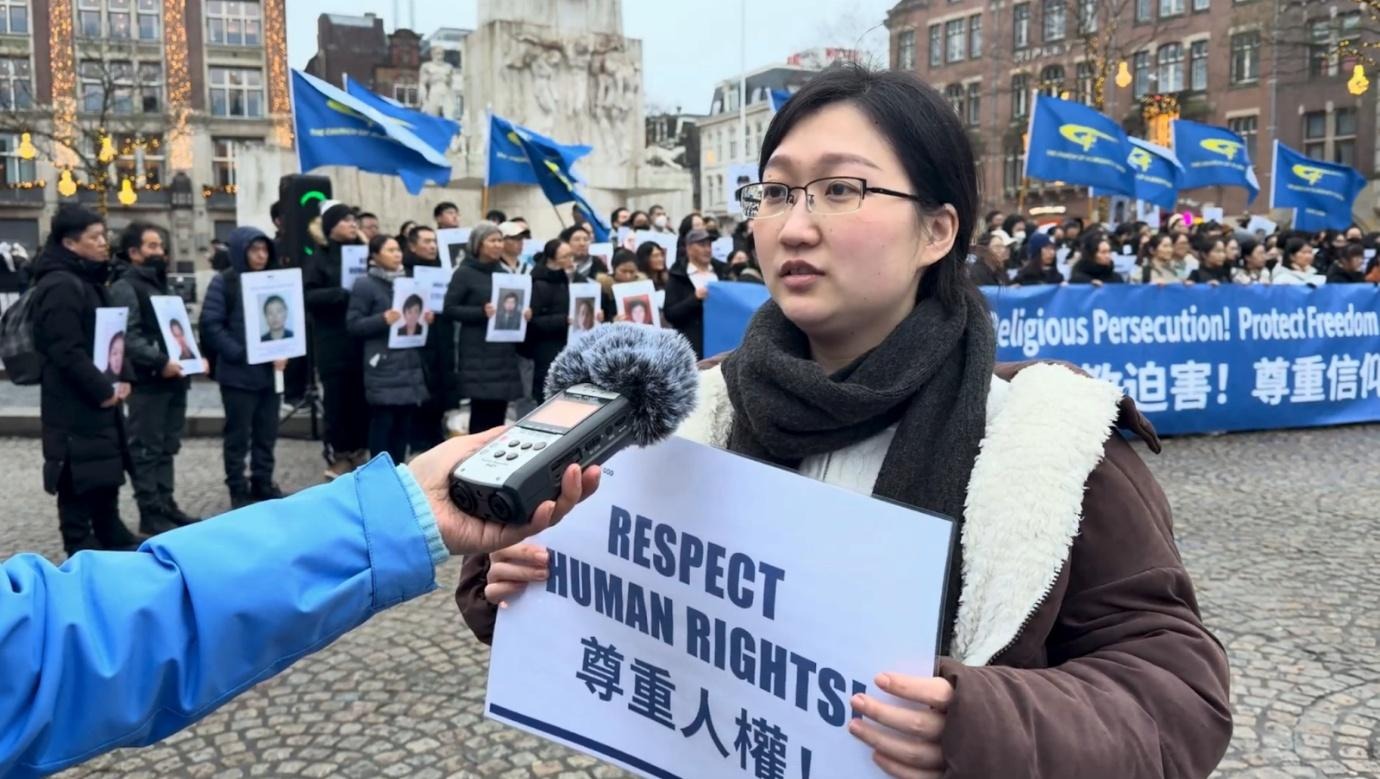
Christian Chen Jing said in an interview that she was pursued by the CCP authorities in China because of her faith, forcing her to separate from her family. She added that many Christians around her have also endured brutal persecution. She pointed out that tens of thousands of CAG Christians are arrested every year, and that many have died after being subjected to torture during interrogation or imprisonment. She said the CCP’s trampling of religious freedom and fundamental human rights is simply outrageous. Chen expressed hope that events like this would help more people see the true state of human rights and freedom of belief in China, and would prompt the international community to pay attention to and assist victims of persecution.
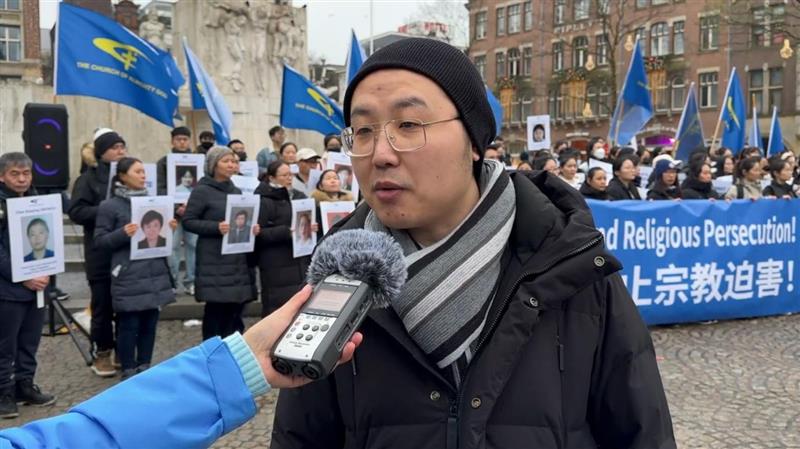
Christian Youxin spoke about his feelings after taking part in the event. Seeing so many people who have suffered persecution gather for International Human Rights Day made him feel the warmth and strength of unity. Reflecting on his experiences in China, he said: “There were several times when I was nearly arrested by the CCP police. I was truly afraid, but it was through God’s protection that I was able to flee China. Today, being overseas, we have the opportunity to expose to the world the CCP’s brutal persecution of Christians of The Church of Almighty God, and to help more people see the harsh reality of human rights and freedom of belief in China.” He called on the international community to extend a helping hand and provide protection for believers seeking asylum.
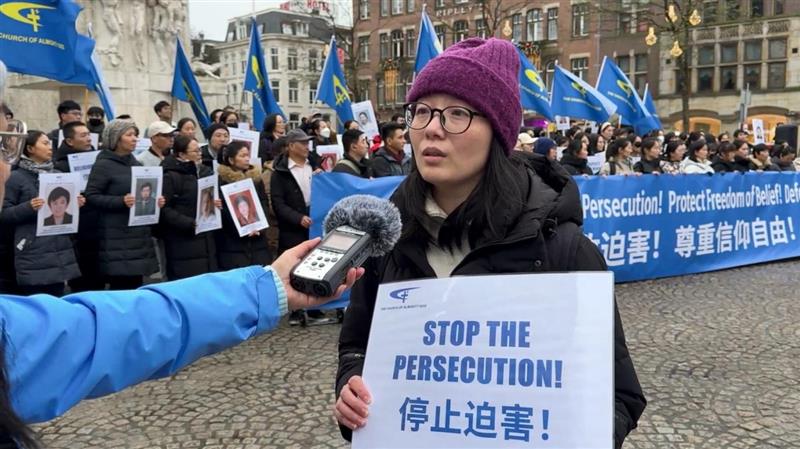
Jinwei said that after fleeing China and arriving in a country that upholds freedom, democracy, and respect for human rights, being able to take part in International Human Rights Day events allowed her to truly feel how precious freedom and human rights are. She said: “Here, I can freely read God’s words and worship God. But whenever I think of the countless brothers and sisters who are still suffering persecution, my heart feels heavy. Through today’s event, I hope more people will come to understand the reality of religious persecution in China, pay attention to the persecution faced by Christians in China, and speak out for them. I also hope that one day they will gain genuine freedom of belief.”

Christian Xiang Ming said that her strongest impression from participating in the event was personally experiencing how free and democratic countries value and respect human rights. She noted that here, people can freely take part in public activities and express their views without restriction. In contrast, in China, Christians are suppressed and persecuted by the CCP simply for believing in and worshiping God, with some subjected to torture or even persecuted to death. Xiang Ming said: “Every time I hear about these cases, I feel an even deeper hatred toward the CCP. It despises and tramples on religious freedom and fundamental human rights, directly contradicting the principles upheld in the Universal Declaration of Human Rights. It should be sanctioned and punished.”
As the rally drew to a close, dark clouds hung low, and cold rain swept across the square on a biting wind. The rain grew heavier, yet not a single participant left. Some held umbrellas; others stood quietly in the rain. Then they sang “Amazing Grace” together in the rain. The hymn’s long, resonant melody carried through the rain and echoed across the square—as if answering the shared call for freedom, faith, and human rights voiced by everyone present.
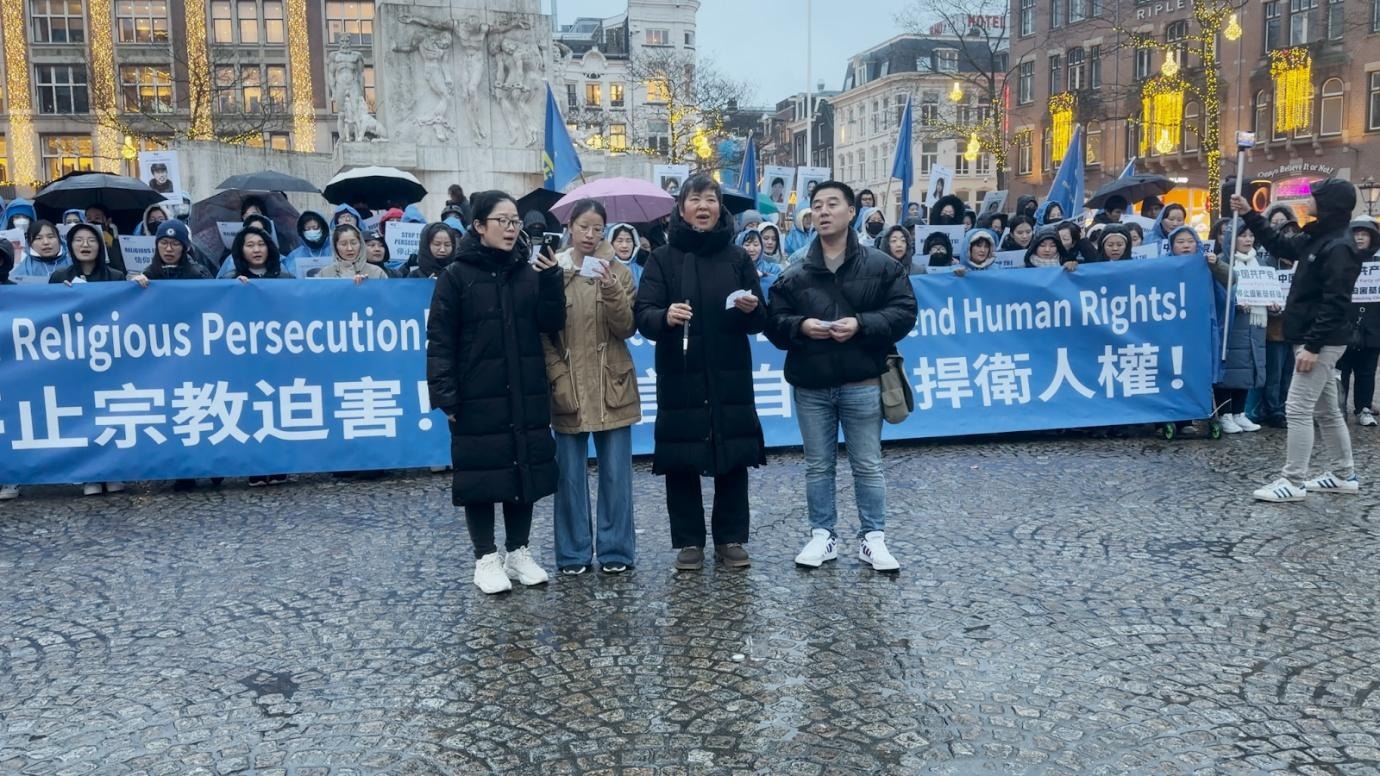
The rally concluded at 4:30 p.m. local time. For many participants, it was not merely a commemorative event, but a public testimony of “saying farewell to fear.” The Netherlands is known for its well-developed system of human rights protections, and the gathering at Dam Square not only allowed the outside world to hear the true voices of the persecuted, but also served as a renewed reminder that freedom of belief and fundamental human rights must never be arbitrarily stripped away by any regime. Regardless of where one may be, every life is entitled to freedom of thought, belief, and expression. The rally also called on the international community to continue paying attention to and help bring an end to the CCP’s ongoing persecution of religious believers and human rights abuses.